Sibelius often associated French titles like Esquisse, Souvenir, Impromptu, and Couplet with a concise, elegant, and transparent piano idiom, mostly without chromatic elements and with restrained emotional expression.
Compositional Technique
The 'Village Church' (Op. 103 No. 1) features broad chords in parallel motion, giving it an organ-like quality, and its main theme moves in a free Palestrina style.
Compositional Technique
Sibelius's 'Petite marche' (Op. 99 No. 8) and his Seventh Symphony both begin with a rising scale passage, and the piano piece is built on a powerful foundation of octaves in the deep bass, suggesting symphonic thinking.
Composer Biography
Sibelius was fascinated by Béla Bartók, one of two contemporary composers he valued most highly; the other was Dmitri Shostakovich.
Compositional Technique
Sibelius's 'The Fiddler' (Op. 103 No. 2) cleverly transcribes various violin tricks, such as sustained notes, double stops, and pizzicati, to the piano.
Composer Biography
In 'Romance' (Op. 101 No. 1), Sibelius, at a mature age, recalls Tchaikovsky, who was the idol of his youth.
Composition History
Sibelius composed 'Morceau romantique sur un motif de M. Jacob de Julin' for a charity event in Helsinki in March 1925, to benefit General Mannerheim's League for the Protection of Children.
You might also enjoy...
Intimate Landscapes for Piano
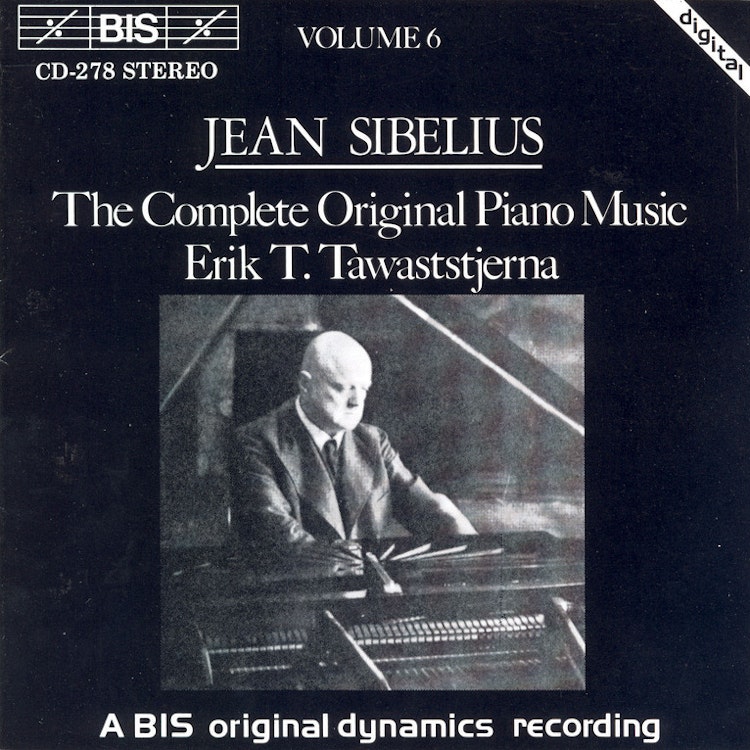
Sibelius: Complete Original Piano Music, Vol. 3
Sibelius Piano Works Volume 3
Sibelius, J.: Piano Music
Sibelius: Piano Music
Rachmaninoff & Gershwin transcriptions by Earl Wild
Sigtenhorst Meyer: Piano Music
Brahms
Sibelius
Incandescence
Janacek: On the Overgrown Path / In the Mists / 1.X.1905
Indy, V. D': Piano Music, Vol. 1 - Poeme Des Montagnes / Tableaux De Voyage / Theme Varie, Fugue Et Chanson