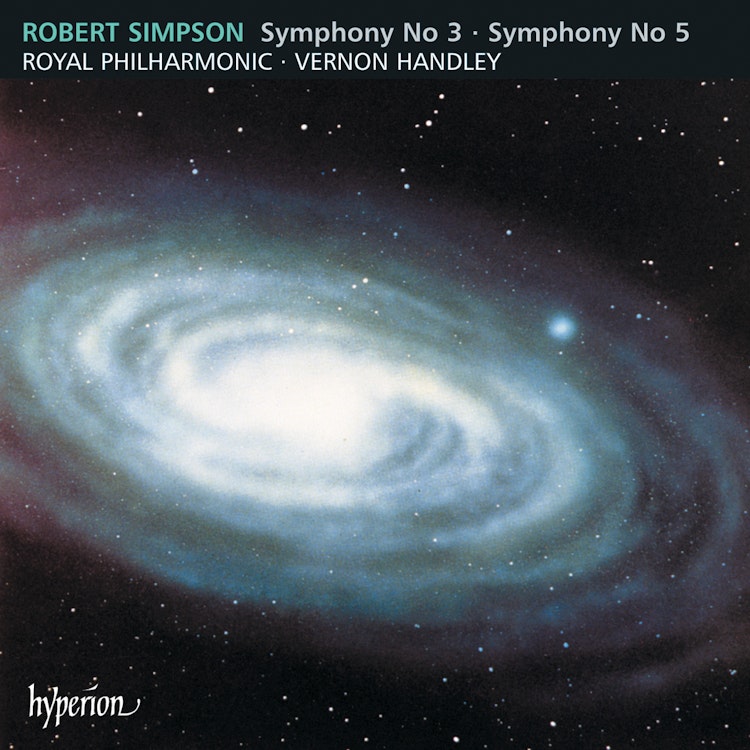
The second movement of Symphony No. 3 is described by Robert Simpson as 'a huge composed accelerando, but with the dynamics repressed,' and is a continuous structure evolving from an initial idea.
Composition History
Robert Simpson's Symphony No. 5 was completed in 1972 and dedicated to the London Symphony Orchestra, which premiered it on May 3, 1973, conducted by Andrew Davis.
Composer's Artistic Vision
Robert Simpson suggested that the second movement of his Symphony No. 3 is 'nature music' and the only piece of his with an origin in an external situation.
Compositional Technique
Symphony No. 5 requires Robert Simpson's largest orchestra to date, including four trumpets, four trombones, two tubas, and two sets of timpani.
Composer's Artistic Vision
In Symphony No. 5, a soft chord with three interlocking tenths represents, in Robert Simpson's words, 'the part of the mind that quietly watches you, regardless of the sort of experiences you are having.'
Composition History
Robert Simpson's Symphony No. 3 was commissioned by the City of Birmingham Symphony Orchestra and dedicated to Havergal Brian, who had dedicated his own Symphony No. 13 to Simpson three years prior.
Composer's Artistic Vision
Like many of Robert Simpson's works from the 1950s and 1960s, Symphony No. 3 uses 'emergent tonality,' where a conflict between two opposing tonal centers, C major and B flat, is pursued.