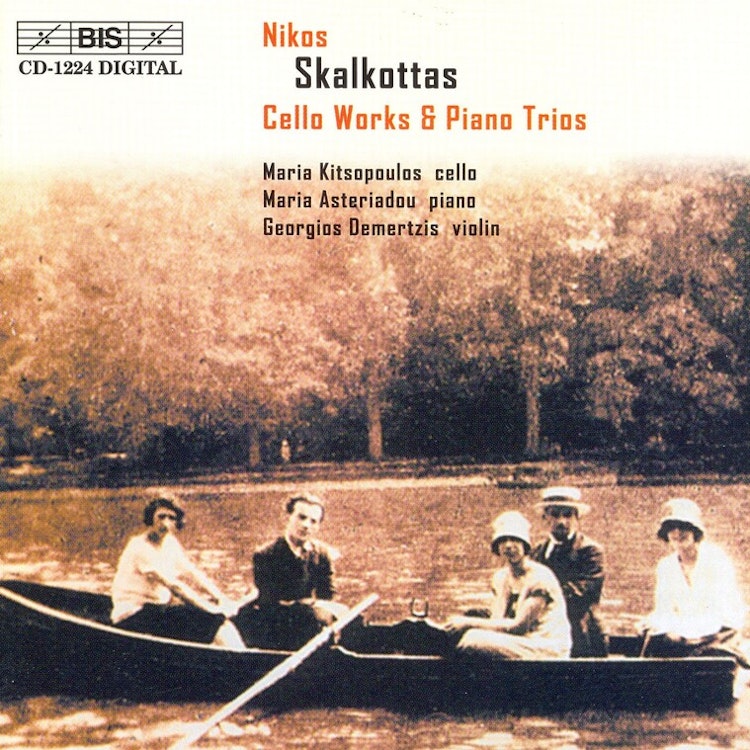
Skalkottas intentionally composed his orchestral works for 'mass consumption' and 'popular education,' while his chamber music was aimed at a 'more exalted public.'
Composer Biography
Skalkottas studied composition under Arnold Schoenberg, a highly influential figure in 20th-century music known for developing the twelve-tone technique, at the Academy of Arts from 1927 to 1933.
Composer Biography
Nikos Skalkottas, the composer, began violin lessons at age five and completed his studies at the Athens Conservatory by 1920.
Composer's Artistic Vision
Skalkottas was a controversial figure in 20th-century Greece because he composed a large portion of his music using both dodecaphonic (twelve-tone) methods and tonal styles.
Composer's Artistic Vision
Skalkottas believed that for him, the twelve-tone system was merely a method, just like the heptatonic system, and not a rigid ideology.
Compositional Technique
The Bolero by Skalkottas is an extreme example of his technique of basing characteristic and approachable pieces on strict dodecaphonic foundations.
Recording & Production
This recording was made in September 2000 at the Megaron Concert Hall in Athens, Greece, using Neumann microphones and a Neve Capricorn digital mixer.
You might also enjoy...
Milo
Prokofiev & Kabalevsky
J. S. Bach, Brahms & Britten
Wigmore Hall Live - Miklós Perényi & Dénes Várjon
Cello Recital: Wallfisch, Raphael - Zemlinsky, A. Von / Goldmark, K.
Songs from the Arc of Life
Nana
Dvořák
Albert Dietrich, Johannes Brahms, Robert Schumann, Theodor Kirchner: Romantic Music for Cello and Piano