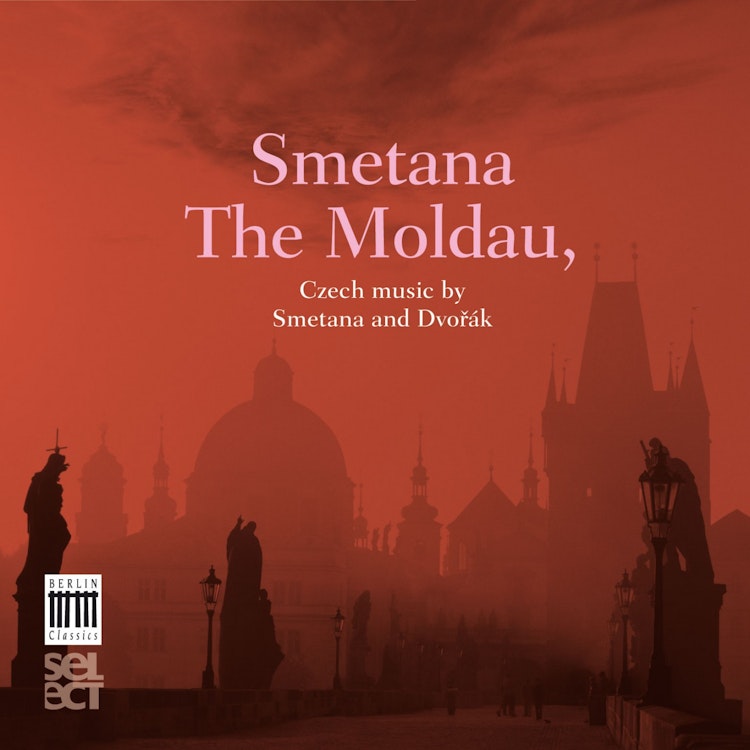
Smetana: The Moldau - Dvořák: Czech Suite & Nature, Life, Love
5/17/2013, 15 Tracks, 2:32:31
Featuring
Theodore Kuchar
Janáček Philharmonic Orchestra
Bedřich Smetana
Antonín Dvořák
Did you know?
1/7
Compositional Technique
A shared melody appears in all three of Dvořák's overtures: 'In Nature's Realm,' 'Carnival,' and 'Othello,' connecting them thematically.
Critical Reception
Dvořák's Symphonic Variations initially received little attention at its 1877 premiere, but gained significant success in London in 1887 thanks to conductor Hans Richter.
Composition History
Dvořák's Česká suita (Czech Suite) was premiered on May 16, 1879, in Prague, conducted by Adolf Čech, at a concert organized by the Czech Journalists' Association.
Composition History
Dvořák's three concert overtures, 'In Nature's Realm,' 'Carnival,' and 'Othello,' were originally conceived as a single work titled 'Nature, Life and Love' and premiered together in Prague in 1892.
Compositional Technique
In Má vlast, Smetana uses the harp to represent the lyre of Lumír, a legendary singer, and introduces a striking Vyšehrad motif that forms a basic element of the set.
Compositional Technique
Three movements of Dvořák's Česká suita (Polka, Sousedská, and Furiant) are stylized Czech dances, while the Pastorale and Romanza have a Bohemian character.
Composer's Artistic Vision
Bedřich Smetana's Má vlast (My Homeland) is a collection of six symphonic poems reflecting early Czech history and legends.
You might also enjoy...
Offenbach In America
The Danish Star Conductor John Frandsen
Nielsen: Aladdin Suite / Pan and Syrinx / Helios Overture
Stokowski Showcase
Nielsen: Masquerade (Excerpts) / Snefrid Suite / Rhapsodic Overture / Pan and Syrinx
Berlioz: Complete Orchestral Works
Overtures & Ballet Music of the 19th Century
Rimsky-Korsakov, N.A.: Mlada Suite / Overture on 3 Russian Themes / Fantasia on Serbian Themes / Sadko / Russian Easter Festival
Berlioz : Orchestral Works
Opera Overtures And Intermezzos
Romantic Russia - Borodin / Glinka / Mussorgsky / Tchaikovsky