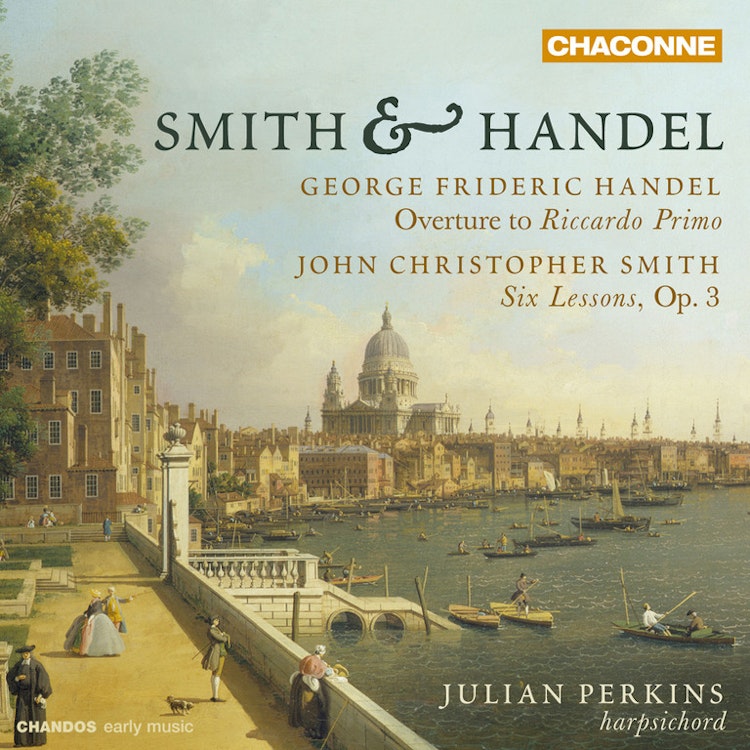
John Christopher Smith's Op. 3, recorded here, was published in 1755, marking his return to keyboard publications after a twenty-year hiatus and his re-entry into theatre work.
Composer's Artistic Vision
John Christopher Smith's music, particularly his keyboard compositions, is described as bubbling over with brilliance, wit, and charm, and often features highly virtuosic elements and Scarlattian traits.
Compositional Technique
John Christopher Smith's Op. 3 exemplifies an 'Anglo-Scarlatti' style, characterized by a comic interplay between baroque and rococo elements, with open textures, playful sequences, and a bias towards classical idioms.
Recording & Production
This album was recorded using 24-bit / 96 kHz technology, which provides a dynamic range up to 48 dB greater and 256 times the resolution of standard 16-bit recordings.
Instruments
Two different harpsichords are used in this recording: a 'fruity English harpsichord' for suites in flat keys and a 'powerful French instrument' for suites in sharp keys.
Composer Biography
John Christopher Smith, the composer of the Six Lessons, Op. 3, was born in Ansbach in the same year as notable figures like Frederick the Great and Jean-Jacques Rousseau.
Composer Biography
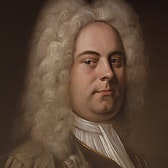
John Christopher Smith's father, also named John Christopher Smith (originally Johann Christoph Schmidt), was Handel's original amanuensis, financial assistant, music publisher, and principal music copyist.
You might also enjoy...
Mayone: Secondo libro di diversi capricci per sonare
J.C. Bach: Piano Trios, Op. 2 & 15
W.F. Bach: Harpsichord Concertos
Orvad, T.: Incontri / Couperin, A.-L.: Simphonie De Clavecins / Mattheson, J.: Suite
Rameau: Pieces de clavecin en concerts
Graupner: Darmstadt Harpsicord Book (Partitas For Harpsichord, Vol. 5)
Bach: Goldberg Variations
Biber, H.I.F.: Sonatas for Strings
Laborde - Rameau
Rameau: Symphonies for two harpsichords / à deux clavecins