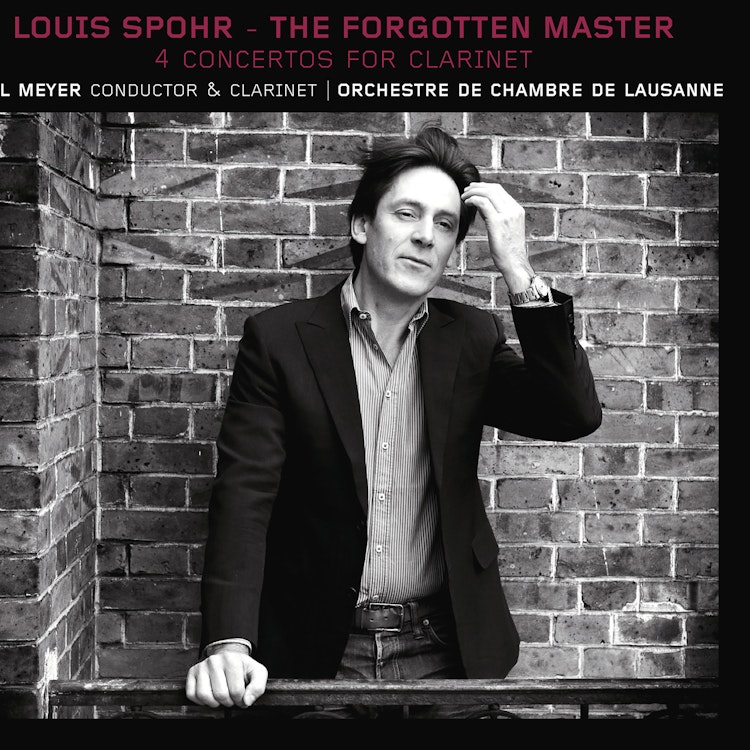
Spohr: The Forgotten Master — 4 Concertos for Clarinet
4/1/2013, 12 Tracks, 1:32:14
Featuring
Paul Meyer
Orchestre de Chambre de Lausanne
Louis Spohr
Did you know?
1/7
Critical Reception
In 1848, the Philharmonic Society of London declared Spohr the "first composer of the day, without a possible rival," praising his universal genius across all styles.
Instruments
The clarinet, an instrument with a cylindrical bore, was relatively new when Spohr composed for it, having been invented in the late 17th century by Johann Christoph Denner.
Compositional Technique
Spohr was a pioneer of early Romanticism in his musical content, but generally retained Classical proportions in his forms, with Mozart being his idol and ideal.
Composition History
Spohr composed nearly three hundred works, including fifteen violin concertos, ten symphonies, thirty-six string quartets, ten operas, and about a hundred lieder.
Composer Biography
Louis Spohr (1784-1859) was not only a composer but also a virtuoso violinist, a renowned teacher, and possibly the greatest conductor of his time.
Composition History
Spohr's works for solo clarinet were written in close collaboration with the virtuoso clarinettist Johann Simon Hermstedt (1778-1846), who was his preferred performer.
Historical Context
Between the death of Beethoven and the rise of Wagner, Spohr was considered by many contemporaries to be the greatest and best-known German composer in Europe.
You might also enjoy...
Spohr: Clarinet Concertos
Live from Tivoli
Crusell, B.H.: Clarinet Concertos Nos. 1-3
Weber : Clarinet Concertos 1 & 2/Concertino in E flat/Clarinet Quintet