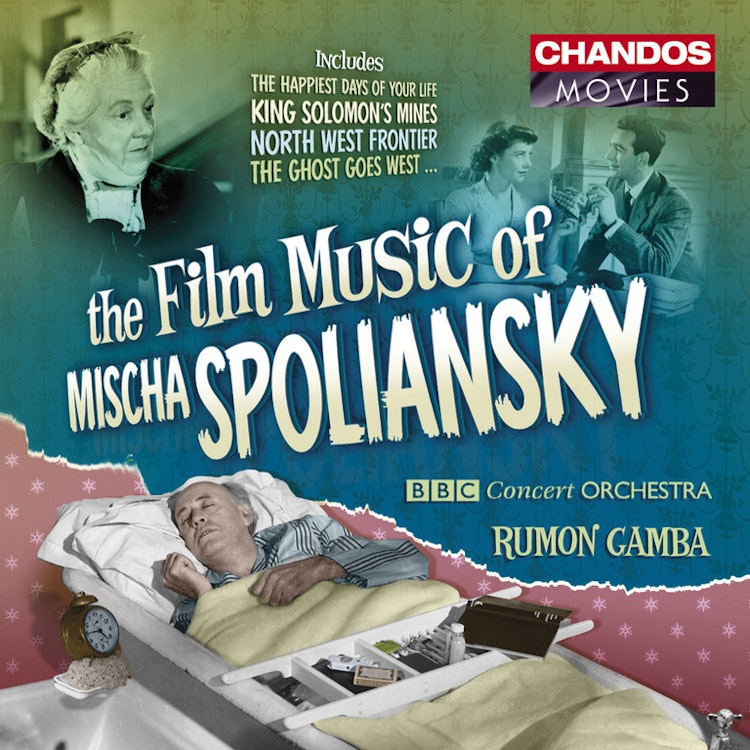
Mischa Spoliansky was expelled from Germany by the Nazis in 1933 and settled in London, joining other Jewish composers like Nicholas Brodsky, Hanns Eisler, Walter Goehr, Allan Gray, and Hans May.
Composer Biography
Mischa Spoliansky, born in 1898 in Białystok (then Russia, now Poland), came from a musical family; his father was an opera baritone, his sister studied with Artur Schnabel, and his brother played cello in the Warsaw Symphony Orchestra.
Instruments
The 'Toccatina' for solo organ from Saint Joan was recorded on a Harrison organ at Cheltenham College Chapel, similar to the Temple Church organ in London where the original organist George Thalben-Ball likely played.
Recording & Production
This album utilizes 24-bit recording technology, which offers a dynamic range up to 48 dB greater and 256 times the resolution of standard 16-bit recordings, enhancing clarity and ambience.
Compositional Technique
The 'Galop' from The Happiest Days of Your Life uses the film's title theme and other material to create a 'wonderfully crazy helter-skelter' piece that reflects the film's chaos and farce.
Critical Reception
Mischa Spoliansky, along with other composers, reportedly turned down the opportunity to compose the famous 'Warsaw' Concerto because they considered it a 'silly idea to ape Rachmaninoff'.
Composition History
Mischa Spoliansky worked regularly in cinema after World War II, scoring diverse projects from Norman Wisdom's debut film, Trouble in Store (1953), to his last film, Hitler: The Last Ten Days (1973).
You might also enjoy...
Graener: Orchestral Works, Vol. 3
Gotovac: Symphonic Poems - Tajcevic: 7 Balkan Dances
Composer's Concert Live: Krzysztof Herdzin
Rock That Flute
Serra: Orchestral Works
Cinema per archi
Schoenberg: Complete Works for Chamber Ensemble
Tansman: Wind Concertos
The Golden Age of Hollywood, Vol. 4
Hallen: Harald Viking - Toteninsel - Schwedische Rhapsodie Nr.2
Hesketh: Diaghilev Dances / Orr: A John Gay Suite / Mccabe: Canyons / Arnold: Water Music