Stanford's composition teacher, Friedrich Kiel, emphasized 'Entwickelung, immer Entwickelung!' (Development, always development!), which became a key aesthetic principle for Stanford.
Critical Reception
Bernard Shaw, reviewing an early performance of Stanford's Irish pieces, praised them for their 'excellent fiddling' and 'entire absence of professorial spirit proper to genuine Irish violinism'.
Composition History
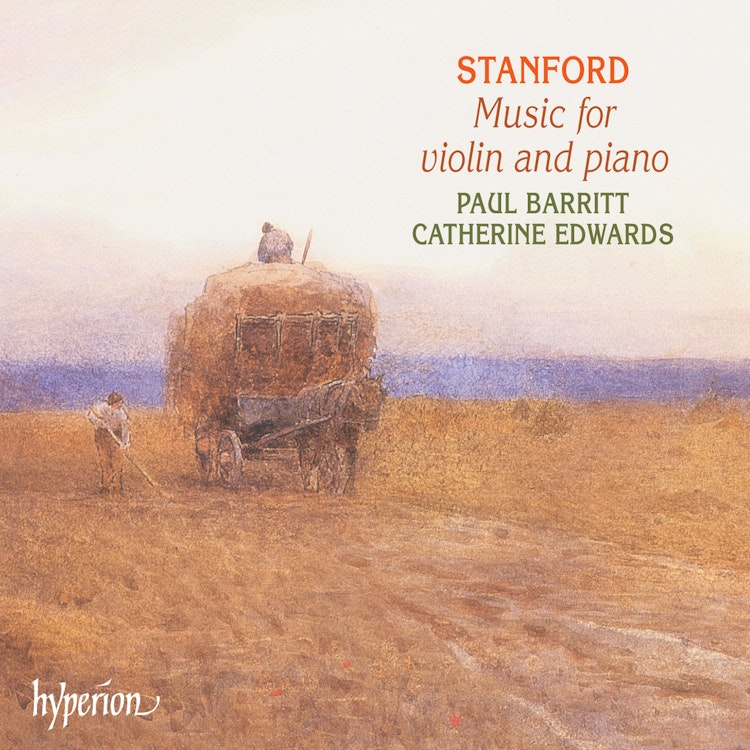
The Violin Sonata No. 2 by Stanford was never published and only survives in a single copyist's score, likely composed around 1898.
Composition History
Stanford's Violin Sonata No. 1 was written for his friend Ludwig Straus, an Austrian violinist who had settled in England and was 'solo violinist' to Queen Victoria.
Composer Biography
As a teenager, Sir Charles Villiers Stanford, the composer, met the great Austro-Hungarian virtuoso violinist Joseph Joachim, who was a friend of Stanford's father.
Performer Biography
Paul Barritt, the violinist on this album, has performed the Schnittke Concerto Grosso No. 1 in Japan at the Suntory Hall in the presence of the Crown Prince of Japan.
Composition History
The Six Irish Fantasies, including the Caoine, were written by Stanford to capitalize on the demand for music based on Irish traditional repertoire.
You might also enjoy...
Lithuanian Music for Violin and Piano
Strauss: Sonata for Violin and Piano Op. 18 / Dvořák: Romantic Pieces for Violin and Piano Op. 75 / Kreisler: Schön Rosmarin; Liebesleid; Syncopation; Marche miniature viennoise
Duo animé
Charles Ives: Four Sonatas
Langgaard: Complete Works for Violin & Piano, Vol. 1
Franck: Violin Sonata in A major - Saint-Saëns: Violin Sonata No. 1 - Messiaen: Theme and Variations
Prokofiev: Complete Original Works for Violin & Piano
Reger: Violin & Piano Works, Vol. 2
Dancla, C.: Petite Ecole De La Melodie / Saint-Saens, C.: Violin Sonata No. 1 / Massenet, J.: Meditation
Goedicke: Music for Violin & Piano
Bacewicz, Prokofiev & Pärt: Works for Violin & Piano