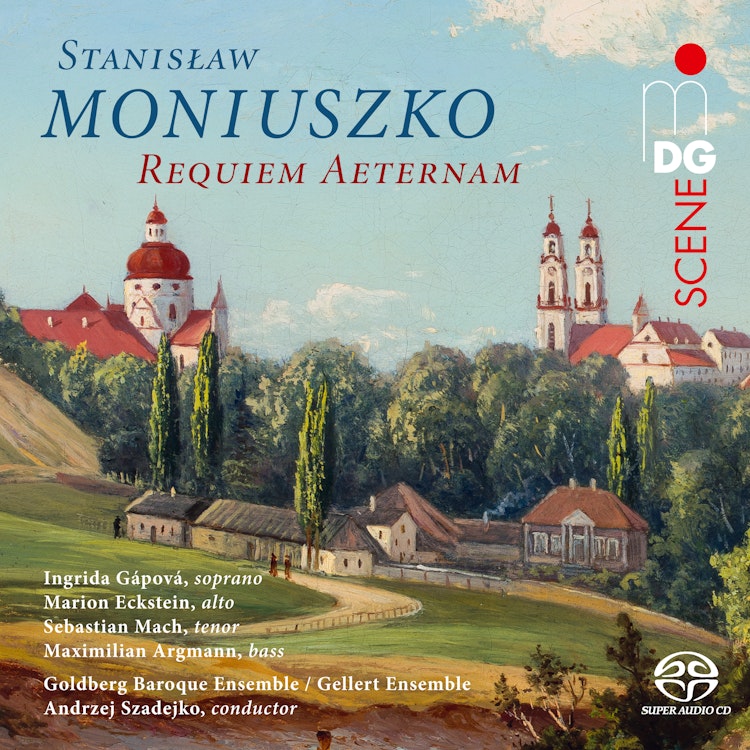
Moniuszko studied in Berlin from 1837-1840 with Carl Friedrich Rungenhagen, a famous teacher and conductor, where he learned harmony, counterpoint, orchestration, and conducting.
Compositional Technique
The Litanies of Ostra Brama show an evolution in Moniuszko's compositional style, moving from a classical instrumentation in the first litany to a more symphonic approach in the third.
Compositional Technique
Moniuszko's Requiem aeternam, a relatively short work for 11 solo voices, choir, and orchestra, features vast orchestration and diverse textures, evoking associations with symphonic works by Liszt, Berlioz, and Wagner.
Composer's Artistic Vision
Moniuszko's sacred works, often overshadowed by his operas, are considered by the booklet authors to be his most complete statement, driven by inner need rather than commercial considerations.
Critical Reception
Gioacchino Rossini, a composer Moniuszko held in high esteem, praised Moniuszko's Third Litany for its 'stylistic dignity and religious simplicity' after receiving a dedication.
Composition History
The three Litanies of Ostra Brama were composed in Vilnius between 1843-1855, likely commissioned by the poet Tomasz Zan.
Composer Biography
Stanisław Moniuszko, born in Ubiel near Minsk (present-day Belarus), began his musical education on piano under his mother's supervision.
You might also enjoy...
Heavenly Voices
Ihr Kinderlein kommet (Der Dresdner Kreuzchor singt die schönsten Weihnachtslieder)
The Reeds by Severn Side
Wesley, S.S.: Anthems
Brahms: Motets
Choral Concert: Zurich Boys Choir - Bach, J.S. / Gounod, C.-F. / Bruckner, A. / Franck, C. / Verdi, G. / Schutz, H. / Mozart, W.A.
Joy to the World: Carols from Worcester Cathedral
Christmas in Europe
Choral Concert: Camerata Musica Limburg - Mendelssohn, Felix / Cornelius, P. / Schubert, F. (Sacred Works for Male Choir)