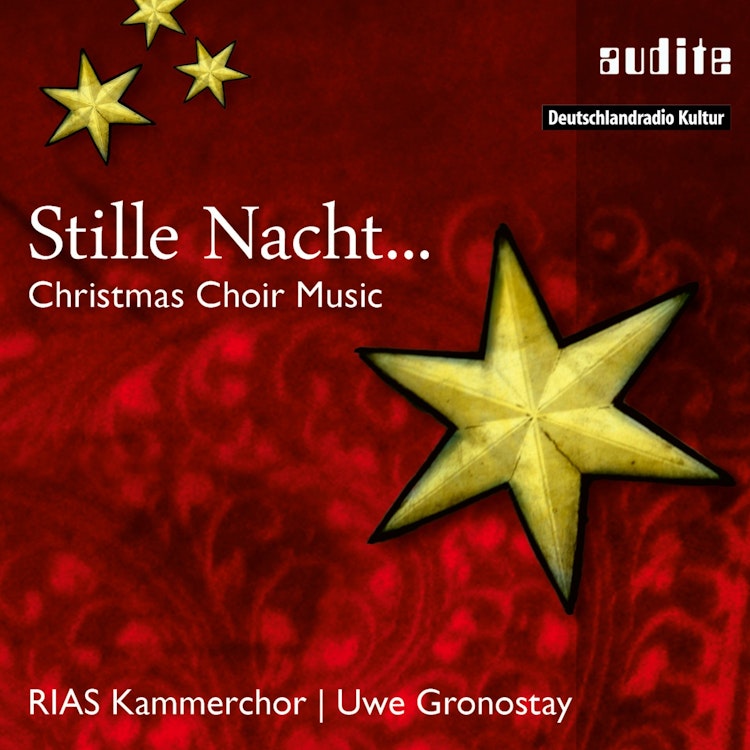
The 1960s saw a renewal in choral singing, with amateur choirs achieving almost professional quality, focusing on pure intonation and a-capella singing, concurrent with the spread of historically informed performance practice.
Performer Biography
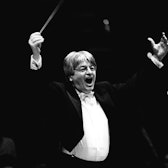
Uwe Gronostay, the artistic director of the RIAS Kammerchor, was a church musician who emerged as an exponent of a new choral culture by founding and directing the North German 'Figuralchor'.
Composer's Artistic Vision
Hans Friedrich Micheelsen, a composer on this album, applied the ideal of 'Gebrauchsmusik' (music for use) from his teacher Paul Hindemith to church practice.
Interpretation
Uwe Gronostay, the conductor, did not primarily differentiate between repertoire for amateurs and professionals, laying the foundation for a clear and flexible choral sound by working on shorter forms of unaccompanied singing.
Recording & Production
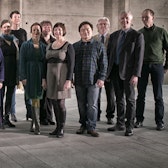
The Christmas carols on this album were recorded by the RIAS (Radio in the American Sector) Berlin between 1972 and 1986, spanning the entire era of Uwe Gronostay's artistic directorship of the RIAS Kammerchor.
Compositional Technique
Wolfgang Jehn, a composer featured on this album, differentiated his choral movements into a main vocal part carrying the melody and accompanying voices singing vowels, consonants, or syllables.
Compositional Technique
Johann Nepomuk David, a master of counterpoint, composed a pre-Christmas motet by interweaving four textual and melodic levels, including an early church antiphon, an Ambrosian hymn, its German version by Martin Luther, and a verse from the Revelation of St. John.
You might also enjoy...
Christmas Music from King's
40
The Mystery of Christmas
Yulefest! - Christmas Music & Carols from Trinity College Cambridge