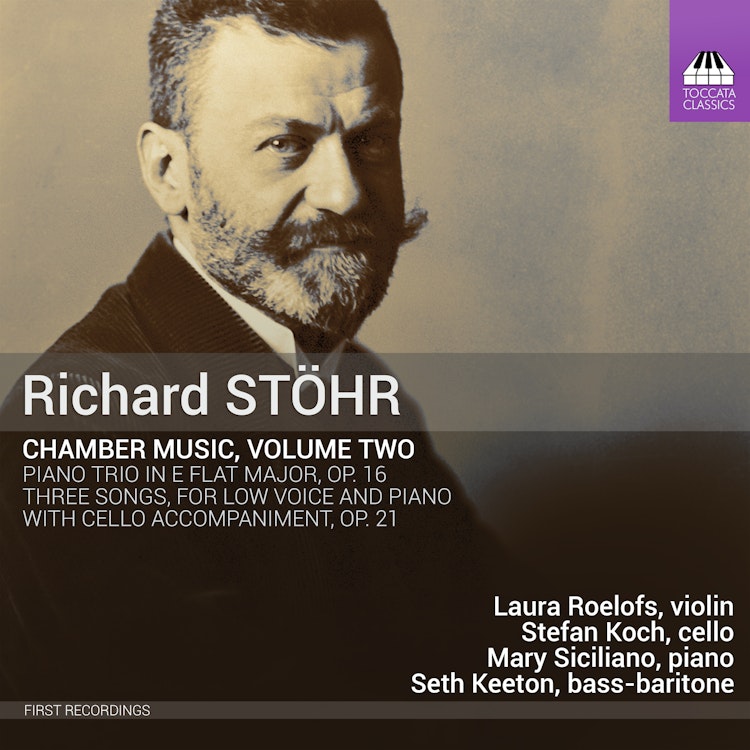
After the Anschluss in March 1938, Richard Stöhr was identified as Jewish by Nazi officials and fired from his position at the Academy of Music, leading him to emigrate to the United States in 1939.
Performer Biography
Stefan Koch, the cellist on this album, undertook a series of recitals in 2012 presenting the first US performances of Richard Stöhr's music for cello and piano.
Composer Biography
Richard Stöhr's uncle, Heinrich Porges, was a close associate of Richard Wagner, a Jewish musician paradoxically surrounded by the anti-Semitic Wagner.
Composition History
Richard Stöhr's Piano Trio, Op. 16, and Three Songs, Op. 21, were not known to have been performed after 1938 until the musicians on this album began performing them in 2015 and 2017, respectively.
Composer Biography
Richard Stöhr, born Richard Stern, initially earned a medical degree from the University of Vienna in 1898 but never practiced, choosing instead to pursue music.
Composer Biography
Richard Stöhr taught thousands of students during his fifty-year career, including notable figures like Samuel Barber, Leonard Bernstein, Marlene Dietrich, and Herbert von Karajan.
Composer Biography
In 1898, Richard Stöhr changed his name from Stern to Stöhr and converted to Christianity, marking a significant turning point in his life.
You might also enjoy...
Milhaud: Early String Quartets & Vocal Works, Vol. 3
Parlami d'amore: Le più belle canzoni italiane
En Italie
Wolf: Italienisches Liederbuch
Don Quichotte à Dulcinée
Tchaikovsky: Piano Trio, Op. 50
Canción para la Navidad
T. Giordani: Caro mio ben
R. Clarke: The Seal Man
Mahler : Das Lied von der Erde - Piano Version
Silvestrov: Silent Songs / 11 Songs: No. 9, Autumn Song
Tosti: L'Ultima Canzone
Tosti: Ideale
Hugo Wolf: Mörike-Lieder (Edition Fischer-Dieskau, Vol. I)