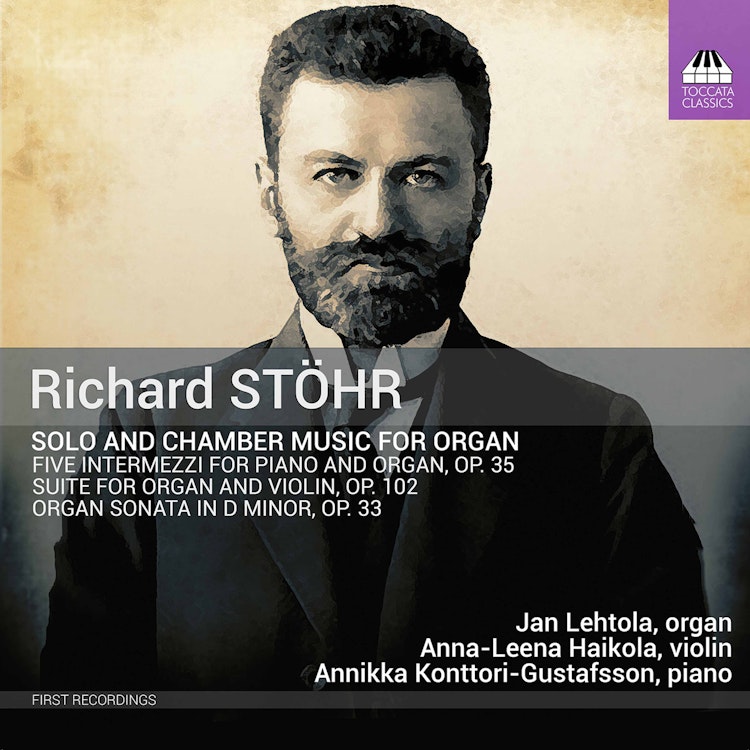
During his fifty-year teaching career, Richard Stöhr's students included notable figures such as Samuel Barber, Leonard Bernstein, Marlene Dietrich, and Herbert von Karajan.
Composer Biography
Stöhr was fired from his position at the Academy of Music after the 1938 Anschluss due to his Jewish heritage and emigrated to the United States in 1939.
Composer Biography
Stöhr initially earned a medical degree from the University of Vienna in 1898 but immediately pursued music, entering the Vienna Academy of Music as a composition student.
Composer Biography
Richard Stöhr (1874-1967) was born Richard Stern in Vienna, the same year as Arnold Schoenberg, and later changed his name and converted to Christianity.
Recording & Production
The album's recordings were made in two different churches in Finland: St Paul's Church in Helsinki for the Organ Sonata and Suite, and Sovituksenkirkko in Hollola for the Intermezzi.
Compositional Technique
The Romantic era saw a significant interest in the harmonium, an inexpensive and portable instrument capable of diverse timbres, with many major composers writing for it.
Interpretation
This recording of Stöhr's Five Intermezzi for piano and harmonium uses an organ instead of a harmonium, as the specific type of harmonium favored by Stöhr is rare in Finland.
You might also enjoy...
Oh Mensch! Gib Acht!
Meeting Leo Brouwer
Orgelpunkt: Glocke Bremen, Vol. 2
Axel Ruoff: Complete Works for Organ, Vol. 3
Flûte et orgue à Notre-Dame de Paris
Jubilissimo
Villa-Lobos: Chamber Music
Spiritual Quest
Danse lente: Chamber Music for Flute & Harp
Diamond, D.: Concert Piece / Tournier, M.: 2 Preludes Romantiques / Saint-Saens, C.: Fantaisie in A Major (Sounds of the Seine)
Gubaidulina: In Croce
Nielsen: Music for Trumpet & Organ
Boulanger, Chaminade & Debussy: D'un matin de printemps