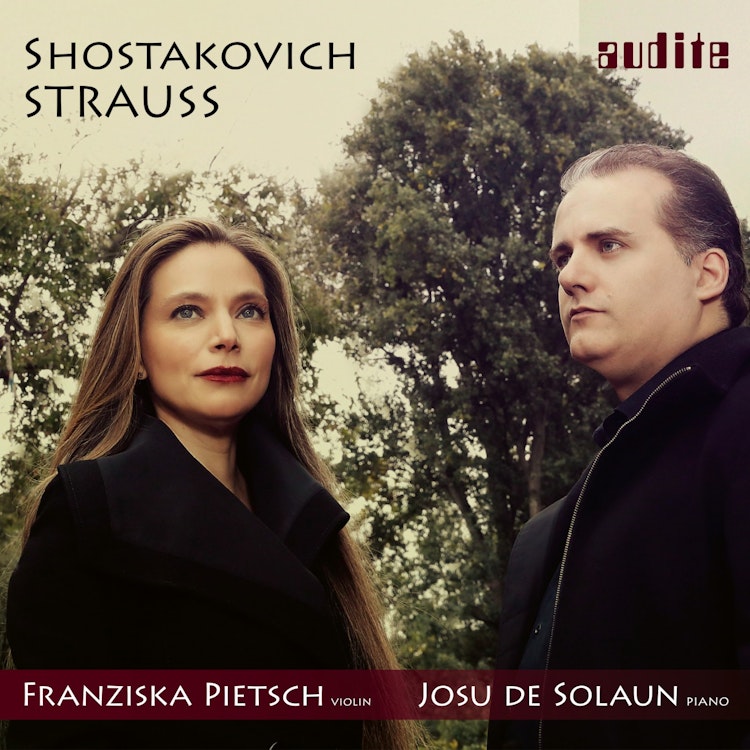
Strauss & Shostakovich: Sonatas for Violin & Piano
3/8/2019, 6 Tracks, 1:03:59
Featuring
Franziska Pietsch
Josu de Solaun
Richard Strauss
Dmitri Shostakovich
Did you know?
1/7
Compositional Technique
The first movement of Shostakovich's Violin Sonata features the violin playing a 'soul-searching confession' based on the DSCH motif, a cryptogram of the composer's initials.
Compositional Technique
Richard Strauss's piano writing is often symphonic in nature, rather than idiomatic, due to his training focusing on the piano as a chamber instrument or for sketching orchestral music.
Composition History
Richard Strauss composed his Violin Sonata in 1887-1888 in Munich, at age 23, while serving as Music Director at the Münchner Hofoper.
Album & Artwork
This album pairs two violin sonatas, one by Richard Strauss and one by Dmitri Shostakovich, composed 80 years apart, to represent a complete life cycle from youthful exuberance to the acceptance of old age.
Compositional Technique
Shostakovich's Violin Sonata uses a twelve-tone theme in the first movement, played by the piano, which the booklet describes as an expressive rather than structural use of serialism.
Composition History
Dmitri Shostakovich wrote his Violin Sonata in 1968, during the Brezhnev era and the dark Moscow winter, dedicating it to David Oistrakh for his 60th birthday.
Composer Biography
Richard Strauss's Violin Sonata coincided with his first meeting with soprano Pauline de Ahna, who would become his wife seven years later, and the work is permeated by their amorous feelings.