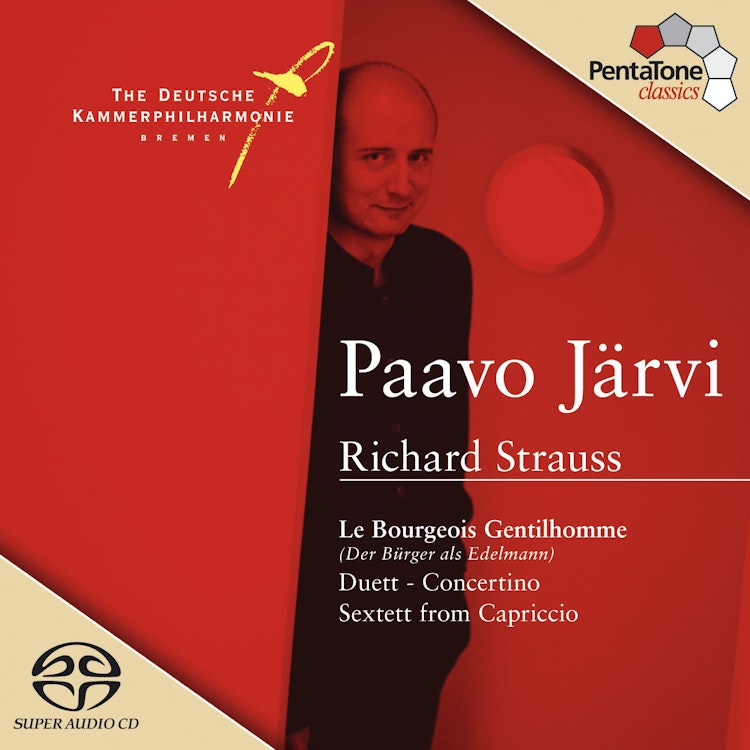
Strauss: Der Bürger als Edelmann / Duett-Concertino / Sextett from Capriccio
1/1/2004, 13 Tracks, 1:05:19
Featuring
Paavo Järvi
Daniel Sepec
Nicole Kern
Higinio Arrué
Die Deutsche Kammerphilharmonie Bremen
Richard Strauss
Did you know?
1/7
Composer's Artistic Vision
Richard Strauss, known for large tone poems and operas, also composed intimate chamber music, which conductor Paavo Järvi particularly loves and presents on this recording.
Composition History
Richard Strauss's opera Capriccio, a 'dramaturgical treatise' on the relationship between text and music, was conceived after discussions with conductor Clemens Krauss and inspired by a text set by Antonio Salieri.
Historical Context
Capriccio, an opera discussing musical aesthetics, was composed in 1942 amidst World War II, a fact for which Richard Strauss was criticized but consciously embraced as an anachronism.
Performer Biography
Paavo Järvi, the conductor, studied at the Curtis Institute of Music and the Los Angeles Philharmonic Institute under Leonard Bernstein and has been the Artistic Director of the Deutsche Kammerphilharmonie Bremen since 2004.
Compositional Technique
The Duett-Concertino for clarinet and bassoon, composed in 1947, features a concertante dialogue between the velvety-smooth clarinet and the humorous bassoon, accompanied by a string orchestra with harp.
Compositional Technique
In Der Bürger als Edelmann, Richard Strauss pays homage to Baroque master Jean-Baptiste Lully by quoting his music, as shown in the fifth movement, 'Menuett des Lully'.
Composition History
The Suite for orchestra: Der Bürger als Edelmann (Le Bourgeois Gentilhomme) was created when Richard Strauss condensed nine incidental pieces from a theatrical experiment into an orchestral suite to save his music for the concert hall.
You might also enjoy...
Myaskovsky / Shostakovich: Chamber Symphonies
Koehne: Time Is A River
Shostakovich, D.: Symphony No. 14 / Adagio and Allegretto
Gershwin: Rhapsody in Blue / Copland: Appalachian Spring / Barber: Adagio for Strings