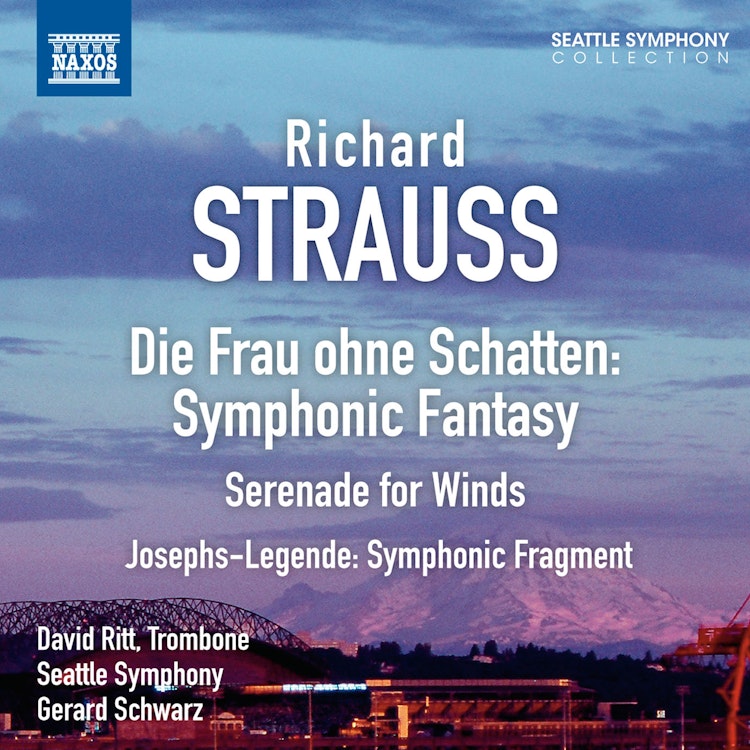
Strauss: Symphonic Fantasy on Die Frau ohne Schatten - Serenade, Op. 7 - Symphonic Fragment from Josephs Legende
4/2/2013, 3 Tracks, 1:01:51
Featuring
Gerard Schwarz
Seattle Symphony
Richard Strauss
Did you know?
1/7
Historical Context
The original opera Die Frau ohne Schatten premiered in Vienna in 1919, a difficult time in the aftermath of World War I, but the German-speaking world welcomed diversion from the prevailing angst.
Composition History
Richard Strauss created symphonic memoirs of his opera Die Frau ohne Schatten and ballet Josephs-Legende, preserving their storylines and tuneful highlights, by reverting to his mastery of the orchestral tone poem.
Performer Biography
David Ritt, the trombonist on this album, began studying trombone at age nine, inspired by its resemblance to his toy slide whistle.
Composer's Artistic Vision
In his later years, Richard Strauss, the composer, revisited some of his favorite scores, such as the opera Die Frau ohne Schatten and the ballet Josephs-Legende, to give them renewed life.
Composer Biography
Richard Strauss's Serenade for 13 Wind Instruments, Op. 7, written when he was about 17, drew the attention of composer, pianist, and conductor Hans von Bülow, whose support was important to Strauss's early career.
Compositional Technique
Richard Strauss's opera Die Frau ohne Schatten uses variable leitmotifs, following Richard Wagner's lead, to portray the characters and their evolving sentiments.
Composition History
The ballet Josephs-Legende was originally completed in 1914 as a commission for the Ballets Russes, led by Sergey Dyagilev, who had also commissioned Igor Stravinsky's Firebird, Petrouchka, and Rite of Spring.
You might also enjoy...
Reger: Variations & Fugue On A Theme By Mozart / Hindemith: Symphonic Metamorphoses On Themes By Carl Maria von Weber
Kletzki, Maklakiewicz & Others: Orchestral Works
Leo Ornstein: Nocturne & Dance of the Fates - Arthur Foote: Francesca Da Rimini - Arthur Bird: Carnival Scene
Docker: Orchestral Works
Docker: Orchestral Works
Docker: 3 Contrasts, Scènes de ballet & Pastiche Variations
Svendsen: Orchestral Works, Vol. 1
Grainger: Grainger Edition, Vol. 4: Works for Wind Orchestra
Mikołaj Górecki: Orchestral & Choral Music
Berio, L.: Rendering / Zender, H.: Chore / Reimann, A.: Metamorphosen On A Minuet of Franz Schubert (Schubert Epilog)
Bach: Orchestral transcriptions by Respighi & Elgar