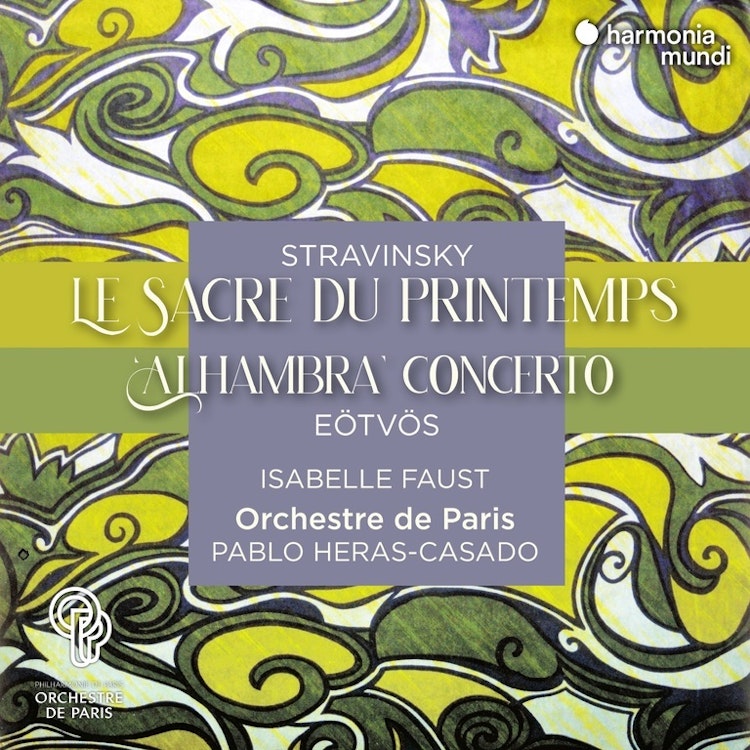
Stravinsky: Le Sacre du printemps - Eötvös: "Alhambra" Concerto
4/9/2021, 14 Tracks, 57:45
Featuring
Isabelle Faust
Pablo Heras-Casado
Orchestre de Paris
Péter Eötvös
Igor Stravinsky
Did you know?
1/7
Compositional Technique
In "Alhambra," Péter Eötvös uses musical cryptograms, translating the letters A-L-H-A-M-B-R-A into the principal melody and weaving the names of Isabelle Faust and Pablo Heras-Casado into the musical structure.
Composition History
Péter Eötvös's "Alhambra" is his third violin concerto, commissioned by Pablo Heras-Casado, director of the Granada Festival, and dedicated to him and violinist Isabelle Faust.
Composer's Artistic Vision
Péter Eötvös's "Alhambra" concerto is inspired by the Alhambra Palace, its fountains, dimensions, surrounding mountains, and the Andalusian sunset, aiming to contribute to the tradition of Spanish and Arabic cultural intersection in Western art music.
Composition History
Igor Stravinsky began conceiving "Le Sacre du printemps" (The Rite of Spring) around 1911, having already gained fame from his work with Serge Diaghilev's Ballets Russes.
Composer's Artistic Vision
Stravinsky stated his intention for "Le Sacre du printemps" was to express "the sublime rise of nature as it is renewed: the total, Panic rise of the universal sap," evoking "pictures of pagan Russia."
Compositional Technique
In "Le Sacre du printemps," Stravinsky uses themes from Lithuanian folklore, irregular meters, syncopated accents, and compound chords to create tension and a deliberately primitive effect.
Critical Reception
Claude Debussy, a renowned French composer, played "Le Sacre du printemps" with Stravinsky in 1912 and described it as haunting him "like a beautiful nightmare."
You might also enjoy...
Riisager: Violin Concerto & Etudes
Bernstein: Serenade, Fancy Free
Tchaikovsky: Violin Concerto in D Major, Op. 35 & Swan Lake Suite, Op. 20a
Glazunov: Seasons (The) / Violin Concerto
Vaughan Williams: Job / The Lark Ascending
Glazunov: Violin Concerto in A Minor / The Seasons