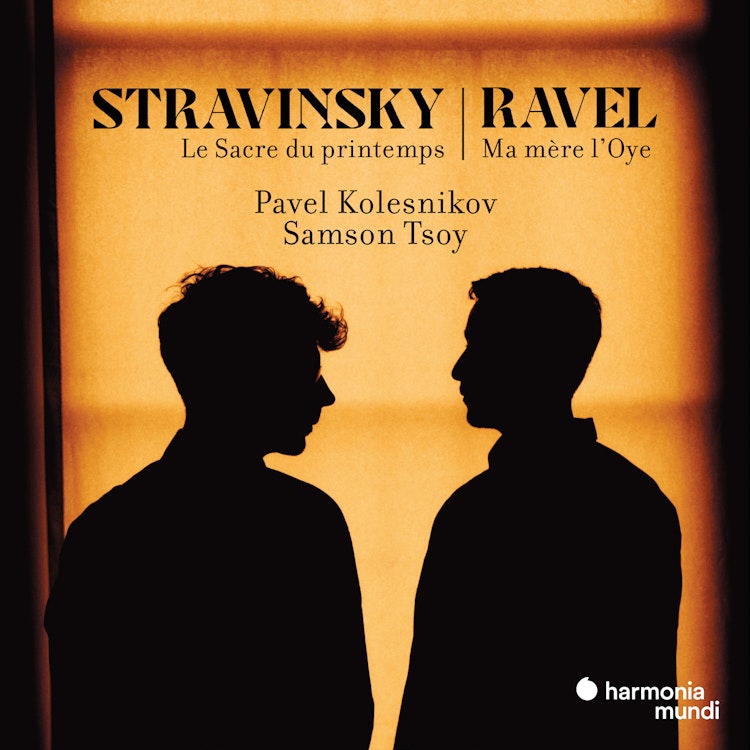
Stravinsky: Le Sacre du printemps - Ravel: Ma mère l'Oye
6/13/2025, 19 Tracks, 49:28
Featuring
Pavel Kolesnikov
Samson Tsoy
Igor Stravinsky
Maurice Ravel
Did you know?
1/7
Interpretation
The performers, Pavel Kolesnikov and Samson Tsoy, consider Stravinsky's own four-hand piano arrangement of The Rite of Spring to be a 'version' rather than a mere 'arrangement'.
Critical Reception
The premiere of Stravinsky's The Rite of Spring on May 29, 1913, was not as scandalous as often portrayed, with the 'uproar' being exaggerated and subsequent performances undisturbed.
Composition History
Claude Debussy, a French composer, first sight-read Stravinsky's The Rite of Spring in its four-hand piano version with Stravinsky himself on June 2, 1912, at the home of Louis Laloy.
Composer's Artistic Vision
Stravinsky intended The Rite of Spring to express 'the sublime rise of nature as it is renewed: the total, Panic rise of the universal sap,' evoking 'pictures of pagan Russia.'
Compositional Technique
In The Rite of Spring, Stravinsky used themes from Lithuanian folk songs, transforming them into musical material, and employed irregular meters and compound chords to create tension and dissonance.
Interpretation
Pavel Kolesnikov and Samson Tsoy believe that a single piano, pushed to its limits by four hands, can be more violent than a hundred strings and winds, deriving its power from rough, angular directness.
Composition History
Maurice Ravel's Ma mère l'Oye (Mother Goose) was inspired by his friendship with Ida and Cipa Godebski, wealthy art-lovers whose children, Mimi and Jean, were the dedicatees of the work.
You might also enjoy...
Prokofiev: Cinderella for 2 pianos / Ravel: Ma Mère l'Oye
York 2: The Composers' Original Scores for Piano Duet
Tchaikovsky: Symphony No. 5 (Arr. for Two Pianos)
Debussy & Stravinsky: Le Sacre
The Koroliov Series, Vol. 17: Stravinsky – Piano Works