Stravinsky's Canticum Sacrum was composed in honor of St Mark, the patron saint of Venice, after a suggestion made during a trip to Rome.
Compositional Technique
Stravinsky's Mass uses only wind instruments—two oboes, cor anglais, two bassoons, two trumpets, and three trombones—combined with a choir of men's and boys' voices.
Composition History
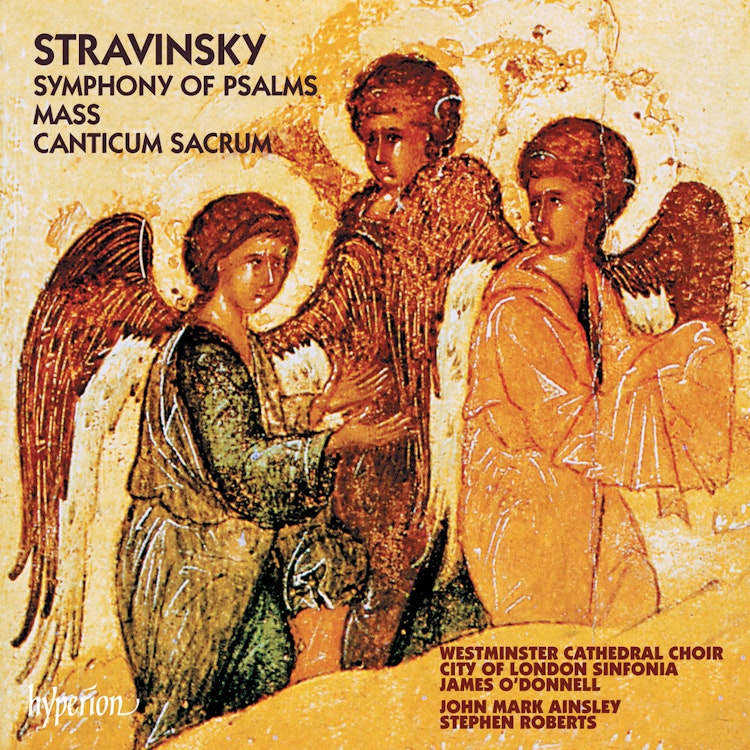
The Symphony of Psalms was commissioned by Serge Koussevitsky to celebrate the fiftieth anniversary of the Boston Symphony Orchestra, but Stravinsky considered its true starting point to be 'à la gloire de Dieu' (to the glory of God).
Composer Biography
Igor Stravinsky returned to the Russian Orthodox Church around 1925 or 1926, though he himself was not clear about the exact year.
Composition History
Stravinsky's Three Sacred Choruses (Pater Noster, Credo, and Ave Maria) were inspired by the poor quality of music and singing in the Russian Church at Nice.
Compositional Technique
The five parts of Canticum Sacrum correspond to the five cupolas of St Mark's Basilica in Venice, with the central part being the most important.
Compositional Technique
The scoring of the Symphony of Psalms notably omits violins and violas, coloring the upper registers entirely with woodwind and brass instruments.