Serge Koussevitzky, who commissioned Stravinsky's Symphony of Psalms, expected a traditional symphony, not a choral work with religious connotations.
Composition History
The Symphony in C was a direct response to American musical life, where the symphony concert was paramount, and was conceived on a "Beethovenian scale" for the New York Philharmonic.
Compositional Technique
The Symphony of Psalms uses an unconventional orchestra without clarinets, violins, or violas, but includes two pianos, with the orchestra often playing a subsidiary role.
Composer Biography
Stravinsky returned to the Russian Orthodox Church in the mid-1920s, influenced by Catholic theologian Jacques Maritain, and read extensively in Catholic devotional literature.
Compositional Technique
Stravinsky's Symphony in C uses melodies that revolve around particular notes, reminiscent of Russian folk songs, found in every movement.
Composer's Artistic Vision
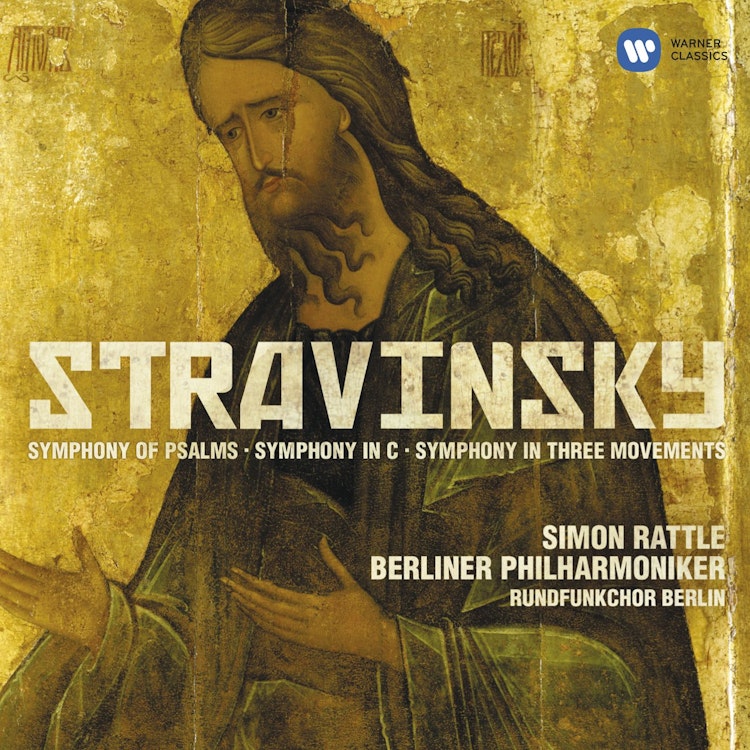
Stravinsky's three symphonies recorded here represent his mature response to the idea of the Classical symphony, composed during his 'neo-Classical' period.
Composition History
The Symphony in Three Movements was commissioned by the New York Philharmonic as a "Victory Symphony" at the end of World War II, premiering in January 1946.