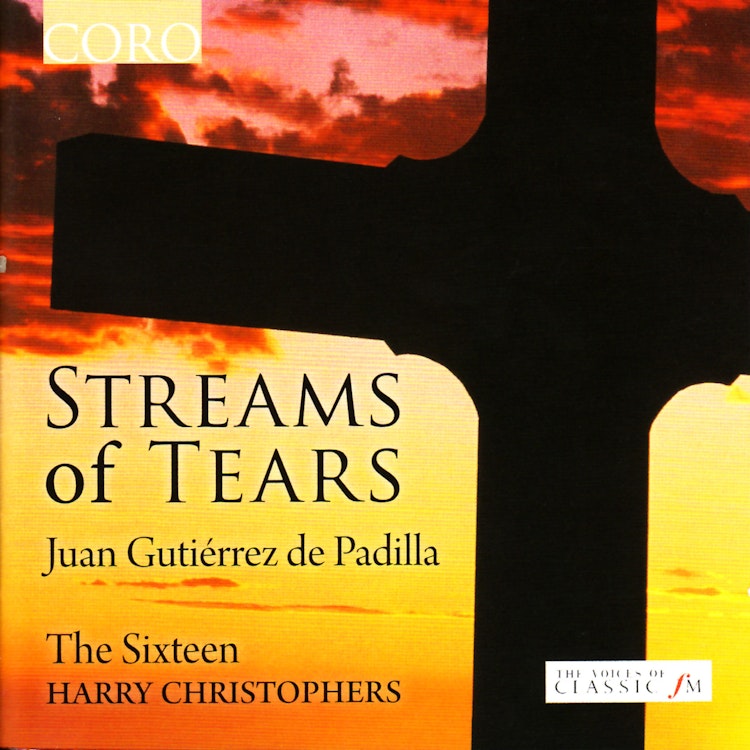
Juan Gutiérrez de Padilla, the composer featured on this album, was born in Málaga, Spain, around 1590 and emigrated to Mexico, becoming maestro de capilla at Puebla Cathedral.
Interpretation
For this recording, instruments such as organ, harp, theorbo, and bajón are used to accompany and double the voice parts, reflecting the lavish instrumental participation common in Padilla's time.
Historical Context
The Spanish conquest of Mexico, led by Hernan Cortés in 1519, resulted in the rapid subjugation of the Aztec nation and a subsequent frenzy of church building in New Spain.
Compositional Technique
Double-choir music for eight voices dominates Padilla's output, a style favored by the layout of Spanish churches where choirs were often bisected in the nave.
Composition History
Padilla's surviving music is largely preserved in a choirbook copied in 1663 by order of the Puebla Cathedral Chapter, demonstrating the high esteem for his work during his lifetime.
Performer Biography
The Sixteen, recognized as one of the world's greatest vocal ensembles, has won numerous awards, including a Gramophone Award for Early Music and a Classical Brit Award for Renaissance.
Album & Artwork
The album title, "Tears of the Baroque," reflects both the program's content—tears shed for Christ—and the historical period known as the Siglo de Oro, when Iberian countries explored new continents.
You might also enjoy...
Choirs of Angels
Aliyah! Israel
Bach's Family: Choral Motets
Crecquillon: Choral Works, Vol. 2
Giordano: Sacred Works
Homilius, G.: Choral Music
Gottfried August Homilius: Sehet, welch eine Liebe. Motetten
Riemuitkaamme!: A Finnish Christmas
Sleep, Holy Babe - A Collection of Christmas Lullabies