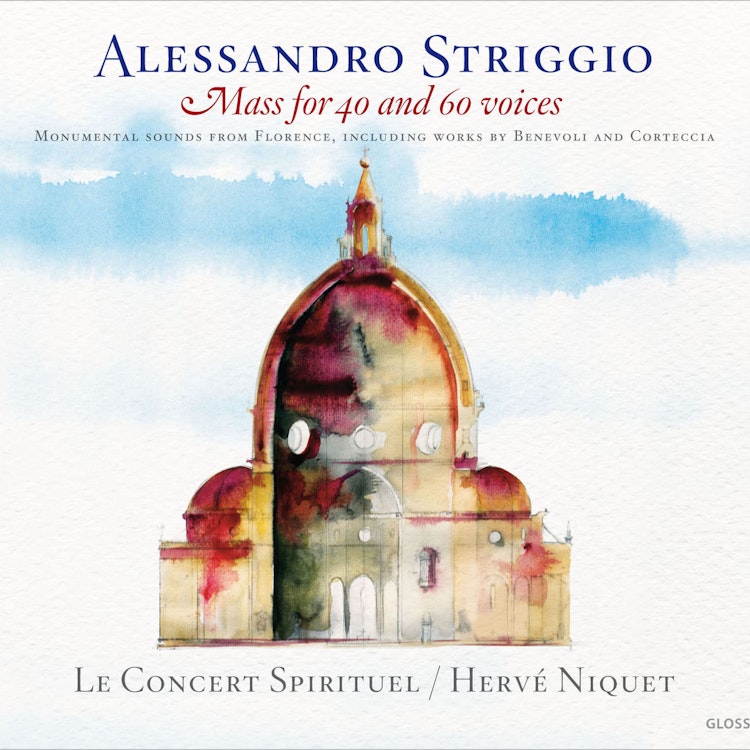
Alessandro Striggio, a Mantuan musician, traveled to various European courts in 1567, carrying his 18-string lira da gamba, an instrument described as "as tall and thick as a man, and somewhat wider."
Critical Reception
Alessandro Striggio's Mass was considered lost by specialists until recently, with its official rediscovery attributed to musicologist Davitt Moroney.
Compositional Technique
The Mass by Alessandro Striggio and the motet Ecce beatam lucem are notable for their "uncommon proportions," being arranged into five choirs, each in eight parts.
Composition History
Striggio's 40-part Mass was performed for King Charles IX of France in Paris in 1567, greatly pleasing the king and the court musicians.
Historical Context
The Mass is placed in its Florentine context, as the Medici family, the rulers of Florence, often commissioned large-scale works for sumptuous ceremonies to reflect their magnificence.
Interpretation
The recording uniquely combines the sounds of four different keyboard instruments: a principal organ, a regal (a 17th-century Tyrolean instrument replica), a harpsichord, and a spinetta ottavina (octave spinet).
Interpretation
This recording of Striggio's Mass features 40 singers (and 60 in the Agnus Dei), with three of the five eight-part choirs doubled by instrumental ensembles to create specific tone colors.
You might also enjoy...
Choral Concert: Helsinki Academic Male Voice Choir - Pacius, F. (Hymn To Finland)