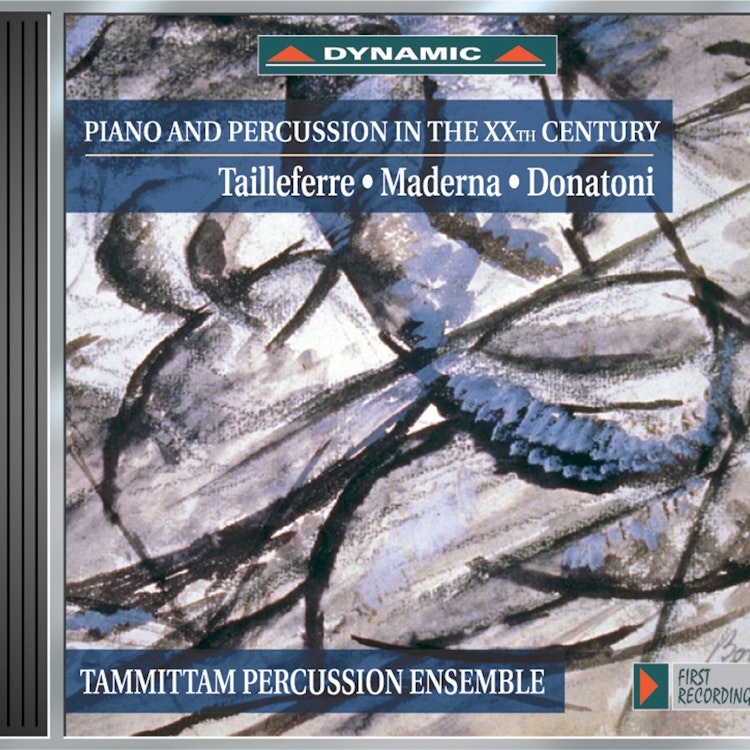
Tailleferre: Hommage A Rameau / Suite Burlesque / Maderna: Concerto for 2 Pianos / Serenata Per Un Satellite / Donatoni: Cloches Iii
7/1/2000, 18 Tracks, 51:40
Featuring
Guido Facchin
Aldo Orvieto
Renato Maioli
Tomasso Castiglioni
Antonio Marotta
Carlo Miotti
Gianluca Carollo
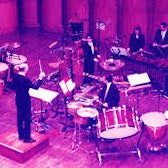
Tàmmittam Percussion Ensemble
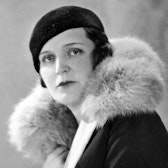
Germaine Tailleferre
Bruno Maderna
Franco Donatoni
Did you know?
1/7
Album & Artwork
This album explores the encounter between piano and percussion instruments, which were largely outside classical music culture, as a source of much 20th-century music.
Composer's Artistic Vision
Bruno Maderna's Concerto, especially in its later version, intentionally broke from classical form, presenting the essence of his poetics by using sound as an objective rupture of silence.
Composition History
Bruno Maderna's Concerto for two pianos and instruments underwent significant revisions; the version on this CD, published in 1955, is a reworking of two earlier versions from 1947-1948.
Compositional Technique
In her Partita, Germaine Tailleferre incorporates a "neo-harpsichord" style for the piano, and uses percussion to rhythmically enrich and color the clear melodic lines, carefully avoiding metal instruments.
Compositional Technique
Bruno Maderna's Serenata per un satellite (1969) belongs to his "chance" period, written on a single sheet with various interpretative paths for different instruments, allowing for compositional indeterminacy.
Composition History
Germaine Tailleferre's Partita pour deux pianos et quatre percussions, also titled Hommage à Rameau, was written in 1964 and dedicated to George Auric, a fellow member of Les Six.
Composer Biography
Germaine Tailleferre, a French composer, was a member of the Parisian group known as "Les Six," alongside composers like Auric, Honegger, Poulenc, Milhaud, and Durey.
You might also enjoy...
Tammittam Ensemble: Piano and Percussion in the 20th Century
Music of Ursula Mamlok, Vol. 2
Jeney: Flute Works
Frank Martin: Ballade - Ernest Ansermet: Morceau de lecture - Émile Jaques-Dalcroze: Deux pièces - Roger Vuataz: Passacaille
Music For Recorder
Bach, J.S.: From the W.F. Bach Notebook / 5 Little Preludes
Polish Piano Preludes Anew
MACDOWELL: Woodland Sketches / Fireside Tales / New England Idyls
Schweiger: Sp19ri9ng One for Piano
Hiller: Buch der Sterne (Book of Stars)
Four
Webern: Complete Piano Music & Works Inspired by Them