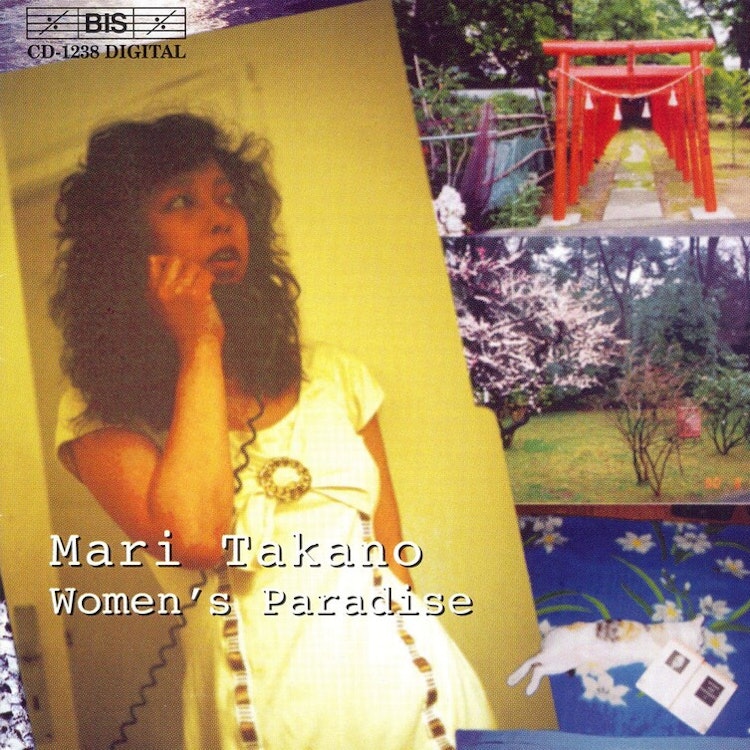
Takano: Women's Paradise / Two Chansons / Innocent
12/1/2003, 10 Tracks, 1:02:56
Featuring
Christine Hintz
Thomas Gramatzki
Mike Rutledge
Hans Peter Reutter
Mari Takano
Christiane Iven
Hubertus Dreyer
Eiko Morikawa
Masayuki Honda
Yoko Nishi
Miki Maruta
Ko Ishikawa
Hitomi Nakamura
Kioko Yasuda
Norio Sato
Did you know?
1/7
Instruments
The work "Mugen No Tsuki - Mugen No Hoshi" features traditional Japanese instruments: the hichiriki (a small oboe), sho (a mouth organ), koto (a thirteen-stringed zither), and jushichigen (a seventeen-stringed bass koto).
Compositional Technique
For "Mugen No Tsuki - Mugen No Hoshi," Mari Takano learned to play the koto for eighteen months to understand the Japanese instruments' way of thinking and playing.
Composer's Artistic Vision
For her "Two Chansons," Mari Takano sought to express the theme of love from a female perspective, contrasting with what she perceived as Schubert's masculine psychological perspective.
Composer Biography
Mari Takano has received numerous awards for her music, including the Mainichi Newspaper Prize, NHK Broadcasting Association Prizes, and the Irino Prize for young composers.
Composer Biography
Mari Takano, born in Tokyo, studied composition under Mutsuo Shishido, Brian Ferneyhough, and György Ligeti.
Composer's Artistic Vision
Mari Takano conceived her work "Women's Paradise" as an "abstract opera," where each of the four pieces tells an imaginary story with overlapping layers of plot and imagery.
Composition History
The "Two Chansons" were commissioned for the Kanagawa-Art Festival in 1997 to commemorate the 200th anniversary of Schubert's birth.