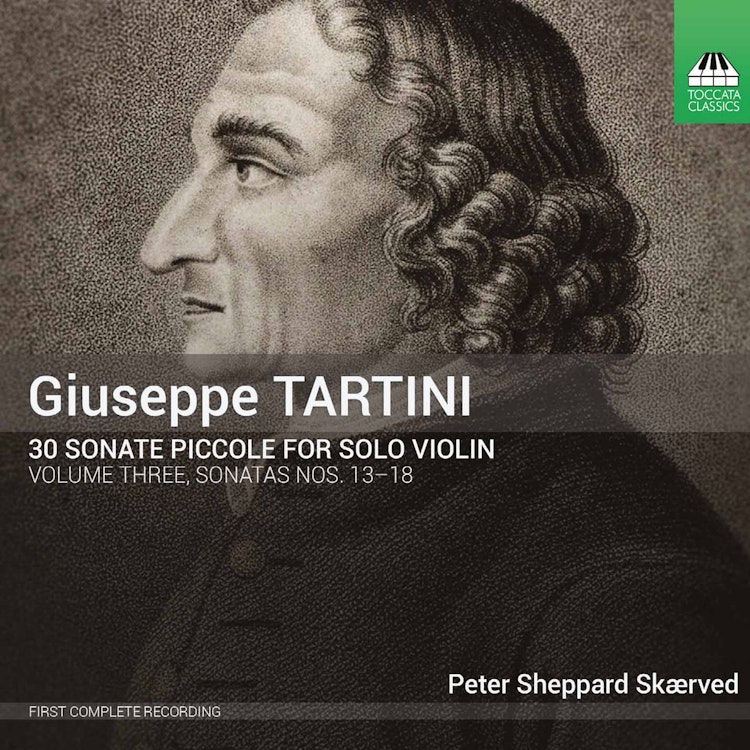
Tartini: 30 Sonate piccole for Solo Violin, Vol. 3
7/3/2015, 28 Tracks, 1:14:27
Featuring
Peter Sheppard Skærved
Giuseppe Tartini
Did you know?
1/7
Composer's Artistic Vision
In his later life, Tartini became increasingly focused on the theory and physics of music, publishing major works on harmony and mathematics.
Composition History
The Sonate piccole form one of the largest integrated sets of sonatas for any instrument, and Tartini worked on them for many years, possibly into his old age, as indicated by changes in his handwriting in the manuscript.
Composer's Artistic Vision
Tartini built his ideal of 'nature-imitation' in music around the phenomenon of the 'third sound,' or 'Tartini's notes,' which is the real physical fundamental bass produced by any given interval or pair of melody lines.
Compositional Technique
Tartini's 'true intention' for the Sonate piccole was for them to be played without a bassetto (cello) part, even though it was sometimes included as a formality.
Composer Biography
Giuseppe Tartini, the composer of these Sonate piccole, was so important in his time that a 90-year-old violinist who had been his student was sought out by the celebrated Nordic violinist Ole Bull 64 years after Tartini's death.
Cultural Impact
Tartini's letter to violinist, composer, and singer Maddalena Sirmen, circulated widely after his death and is still considered an important writing on bow use and practice, influencing the school of violin-playing founded by Giovanni Battista Viotti's disciples.
Recording & Production
The recording aims to present the music as Tartini might have relished, focusing on the close-up sound of the violin, including the grain of the bow on the string and the resultant harmonics, which were important to the composer.
You might also enjoy...
Paganini: 24 Caprices, Op. 1 & Nel cor più non mi sento, MS 44
Paganini: 24 Caprices - Live in Tokyo & Studio version
Tartini: Sonatas for Solo Violin, Vol. 2
Friedrich Hermann: Violin Music, Vol. 1 - Solo Works