The performers on this album improvised all ornaments during the recording, making each take unique, and treated ornamentation as an essential part of the musical language rather than a dogmatic necessity.
Recording & Production
This album was recorded by Little Tribeca in Paris from January 18 to 20, 2017.
Composer Biography
Giuseppe Sammartini, a major oboe figure in the 18th century, was the son of a French oboist, Alexis Saint-Martin, who helped establish the oboe in Italy.
Album & Artwork
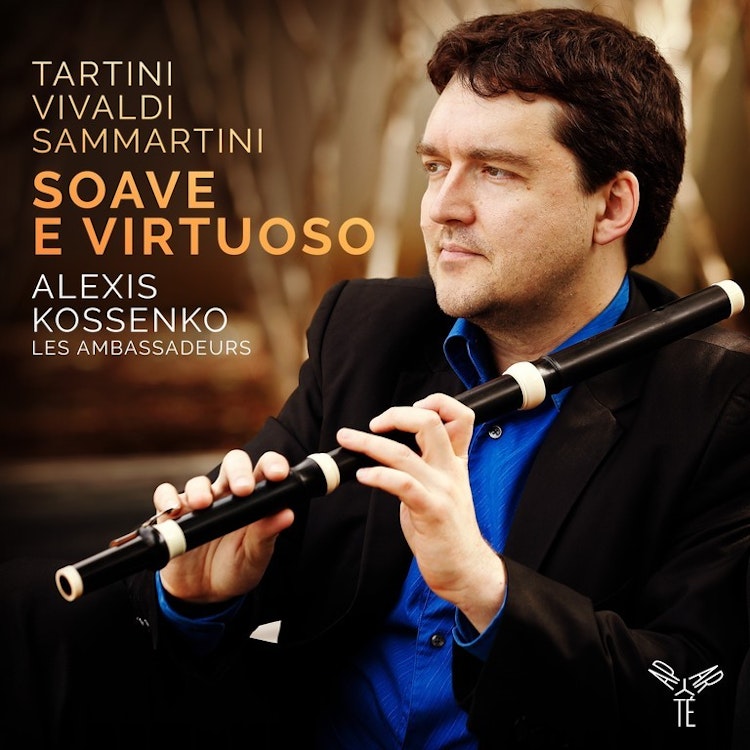
The album title, "Soave e Virtuoso," translates to "Sweet and Virtuous" and features concertos for various flutes.
Compositional Technique
Vivaldi's compositional method involved writing concertos in a single flow, starting with the soloist's line and completing the tutti parts later, often using 'come sopra' to avoid recopying.
Instruments
The flutes used in this recording are historical reproductions: a transverse flute by Martin Wenner (after Carlo Palanca, ca. 1750), an alto recorder by Francesco Li Virghi (after Peter Bressan, ca. 1715), and a soprano recorder by Ernst Meyer (after Jacob Denner, ca. 1720).
Composer's Artistic Vision
Vivaldi's music is described as theatrical, leading listeners into dreams or nightmares, and is evocative, mysterious, and phantasmagorical, much like Venice itself.
You might also enjoy...
Vivaldi: Wind and Brass Concertos
Vivaldi: Concerti
Leonard Bernstein Conducts Vivaldi (Remastered)
Vivaldi: Recorder Concertos
Venetian Flute Concertos
Vivaldi: Concerti per flauto e flautino
Vivaldi: Concerto Alla Rustica
Antonio Vivaldi: Concerti da camera Vol. 2
Vivaldi: Concertos and Chamber Music
La crème de la crème: Vivaldi
Vivaldi: 7 Concerti for woodwind and strings
Vivaldi: 4 Seasons (The) (Arr. for Recorder) / Recorder Concertos