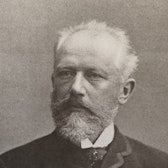
Tchaikovsky initially believed that combining violin, cello, and piano would dilute their individual qualities, stating this in a letter to his patron Nadezhda von Meck.
Composer Biography
Tchaikovsky's life and personality are compared to the tormented characters found in the romantic Russian novels of Pushkin, Dostoevsky, and Tolstoy.
Composition History
Tchaikovsky's Trio Op. 50 was composed to mourn the death of Nikolai Rubinstein, a pianist, composer, and conductor who was a major figure in Russian music and founded the Moscow Conservatoire.
Composition History
Rimsky-Korsakov's trio remained unfinished, and he concluded that "chamber music is not my field."
Performer Biography
The Trio Karénine, founded in Paris in 2009, is named after Anna Karenina, Tolstoy's famous heroine, reflecting the passion and vital momentum that characterize the ensemble.
Compositional Technique
Tchaikovsky's Trio Op. 50 has an atypical structure, breaking traditional codes with its length, internal organization, and virtuosity.
Historical Context
Rimsky-Korsakov was part of "The Five," a group of Russian composers who challenged European influence on Russian music, while Tchaikovsky was viewed with suspicion by them for being a "product of the conservatoire."
You might also enjoy...
History of the Russian Piano Trio, Vol. 3
Shostakovich & Arensky: Piano Trios
Suk, Dvorak & Smetana: Piano Trios
Piano Trios by Ferguson, Piazzolla, and Schoenfield