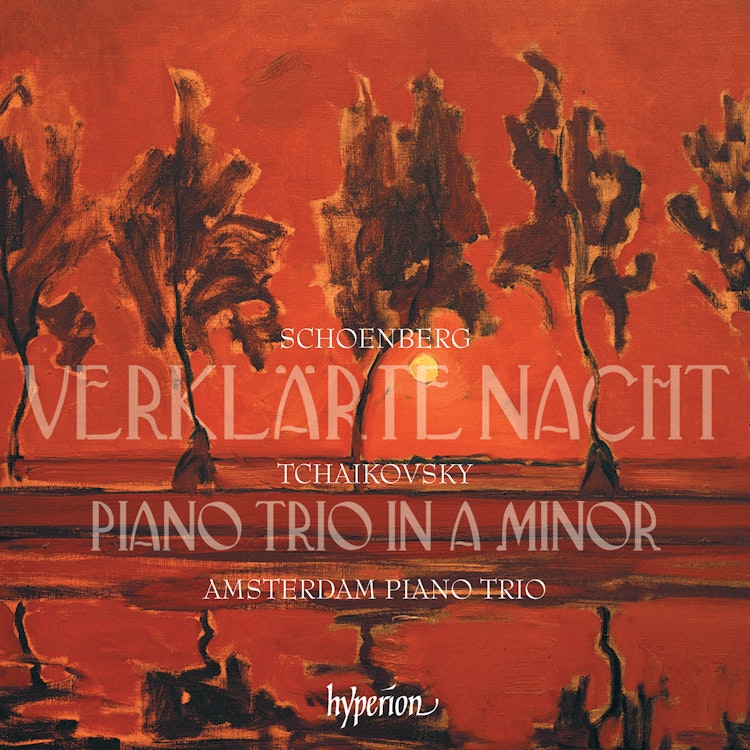
Tchaikovsky: Piano Trio / Schoenberg: Verklärte Nacht
5/1/2026, 17 Tracks, 1:15:03
Featuring
Anna Lipkind-Mazor
Dmitrii Prokofiev
Andrey Gugnin
Amsterdam Piano Trio
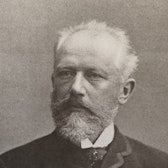
Pyotr Ilyich Tchaikovsky
Arnold Schoenberg
Did you know?
1/7
Critical Reception
Early critics of Schoenberg's Verklärte Nacht were offended by its connection to the notorious poet Dehmel and by its audacious musical language, with the Vienna Music Society singling out a chord that 'did not exist'.
Composer Biography
Verklärte Nacht is widely considered a love letter from Schoenberg to Mathilde, the sister of his music teacher and friend Alexander Zemlinsky, whom he later married.
Composition History
Tchaikovsky's Piano Trio in A minor, Op. 50, carries the subtitle 'In memory of a great artist,' referring to Nikolai Rubinstein, the founder of the Moscow Conservatoire and Tchaikovsky's mentor and friend.
Compositional Technique
Tchaikovsky initially had misgivings about the piano trio genre, worrying that the piano and strings would 'repel each other,' but he approached the task by translating symphonic writing in the first movement and creating innovative chamber music textures in the second.
Composer's Artistic Vision
This album reveals a line of continuity between Tchaikovsky, the great Russian Romantic, and Schoenberg, the great Viennese modernist, a decade before Schoenberg abandoned tonality.
Composition History
Schoenberg's Verklärte Nacht ('Transfigured Night') was inspired by the poetry of Richard Dehmel, a trailblazing poet whose volume Weib und Welt ('Woman and World') explored sexuality from a female perspective.
Critical Reception
Tchaikovsky's emotional expression was initially criticized as 'hysterical' but later reinterpreted as 'psychological realism,' leading to posthumous praise for his ability to create powerful human dramas through music.
You might also enjoy...
Dialogue
Kenneth Leighton: Through the Powerful Darkness... Choral and Organ Music
Shostakovich-Silvestrov
Clarke: Piano Trio / Midsummer Moon / Lullaby / Ives: Piano Trio
DNA
Wilhelm Berger: Clarinet Trio op. 94, Cello Sonata op. 28 & Scherzo for Cello and Piano