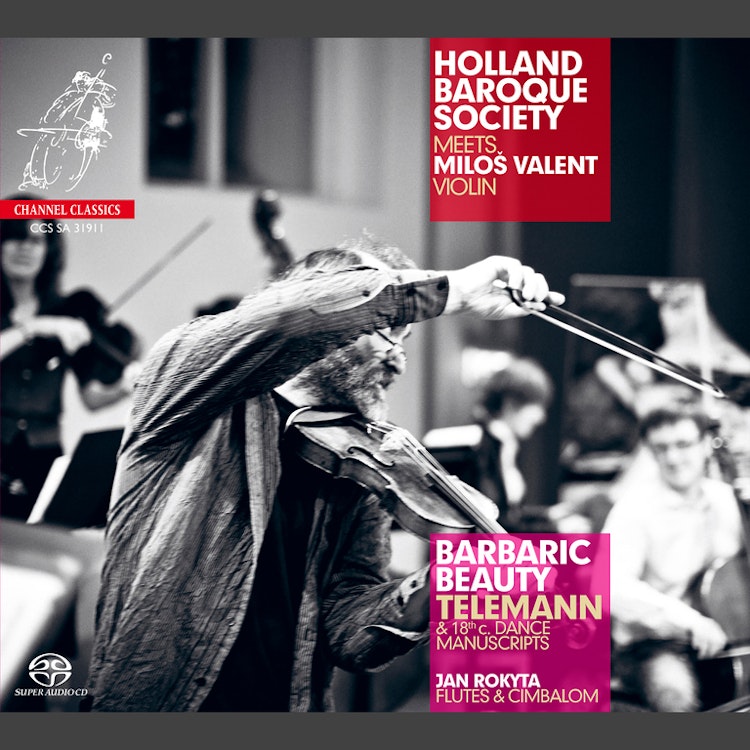
Telemann: Barbaric Beauty 18th Century Dance Transcriptions
10/1/2011, 8 Tracks, 1:17:25
Featuring
Miloš Valent
Jan Rokyta
Holland Baroque
Georg Philipp Telemann
Did you know?
1/7
Compositional Technique
Telemann was particularly interested in the improvisations of folk musicians, noting their "brilliant ideas" when freed from the strict meter of dance music.
Recording & Production
This album was recorded in March 2011 at Westvest, Schiedam, The Netherlands, using high-quality recording equipment including Bruel & Kjaer 4006 and Schoeps microphones, and DSD Super Audio digital converters.
Instruments
Pantaleon Hebenstreit, a contemporary of Telemann, invented a giant cymbal called the Pantaleon, which was nearly three meters long and had 185 gut strings, and was named after him by King Louis XIV.
Composer's Artistic Vision
Telemann, at age 25, was inspired by the "barbaric beauty" of Polish and Hanak (Czech from Moravia) folk music he encountered, which influenced his compositions for the rest of his life.
Compositional Technique
Telemann believed that by transcribing the folk music he heard, one could gather enough musical ideas for a lifetime, and he later incorporated these styles into his large-scale concertos and trios, giving them an "Italian look" with alternating Adagios and Allegros.
Performer Biography
Miloš Valent, the violinist on this album, has roots in folklore tradition and improvising skills, leading him to perform early music as well as various crossover projects with jazz musicians.
Instruments
The Hackbrett, also known as a dulcimer or cymbal, was used in the 18th century, and Telemann collaborated with Pantaleon Hebenstreit, a celebrated violinist and esteemed cymbalist.
You might also enjoy...
Pfeiffer: Overtures & Concertos
Lindblad: Stråkkvintett A-dur / String Quintet in A major - Randel: Stråkkvartett f-moll / String Quartet in F minor
The Next Step
Pichl: Symphonies
Vanhal: Symphonies, Vol. 4
Gentili: Trio Sonatas, Op. 1
À l'ombre d'un ormeau (Alpha Collection)
Nardini: Sonate per violino e basso
The Fiery Genius: Neapolitan Instrumental Music for 1, 2, 3, and 4 Violins
Holzbauer: 5 Symphonies
Costanzi: Cello Sonatas - Giovanni Sollima: Il mandataro
Ristori: Divoti affetti alla Passione di Nostro Signore - Esercizi per l'accompanimento
Børresen: String Sextet in G Major, Op. 5 & String Quartet No. 2 in C Minor