Telemann: Gelobet sei der Herr, TWV 1:602/1216 & Bequemliches Leben, gemächlicher Stand, TWV 1:123
7/1/2022, 43 Tracks, 1:18:42
Featuring
Michael Alexander Willens
Rahel Maas
Elena Harsányi
Elvira Bill
Mirko Ludwig
Klaus Mertens
Mauro Borgioni
André Morsch
Kölner Akademie
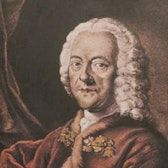
Georg Philipp Telemann
Did you know?
1/7
Composer Biography
The librettos for Telemann's oratorio cycle were written by Albrecht Jacob Zell, a Hamburg-born poet and musician who dedicated his 1735 anthology to his mentor Barthold Heinrich Brockes.
Performer Biography
Michael Alexander Willens, the artistic director of the Kölner Akademie, trained at the Juilliard School and continued his conducting studies with Leonard Bernstein in Tanglewood.
Composition History
In the church year 1730/31, Telemann presented a special concept where full oratorios were to be performed during worship services in Hamburg.
Compositional Technique
Telemann's settings for these oratorios were opulent, utilizing well-equipped ensembles and sometimes requiring additional opera singers due to their rich instrumentation, including four horns and three flutes.
Composer's Artistic Vision
Telemann's oratorios for the 1730-31 church year were designed with a close relationship between music and text, emphasizing vivid imagery.
Historical Context
Oratorios were a well-established genre in Hamburg by the early 18th century, with Passion oratorios regularly performed, though typically only in the cathedral and on selected holidays.
Performer Biography
Klaus Mertens, a bass-baritone on this recording, is unique in having recorded all of Johann Sebastian Bach's vocal works for his voice type, as well as the complete works of Dieterich Buxtehude.
You might also enjoy...
Schütz: Historia der Geburt und Auferstehung Jesu Christi
Antonio Maria Bononcini – La decollazione di San Giovanni Battista