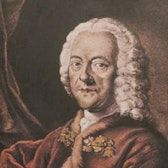
Telemann: Komm wieder, Herr, zu der Menge der Tausenden in Israel, TWV 2:12
3/15/2019, 28 Tracks, 1:11:41
Featuring
Michael Alexander Willens
Klaus Mertens
Julian Podger
Mauro Borgioni
Rahel Maas
Marian Dijkhuizen
Kölner Akademie
Kölner Akademie choir
Georg Philipp Telemann
Did you know?
1/7
Recording & Production
This recording is the first historically accurate reconstruction of the oratorio's original ensemble size and performance practices, relying on a historical-critical edition of the work.
Composition History
The libretto for Telemann's oratorio, written by Joachim Johann Daniel Zimmermann, incorporates details from his sermons given after the 1750 church fire, interpreting the event as an anticipation of the Last Judgment.
Historical Context
The St. Michael's Church fire in Hamburg in 1750 was seen by the city's orthodox clergy, including the oratorio's librettist Joachim Johann Daniel Zimmermann, as a "judgment of God" on the inhabitants.
Historical Context
The dedication ceremony for the new St. Michael's Church on October 19, 1762, was a major civic and religious event, attended by over 5,000 people and featuring a procession with trumpets and timpani.
Composition History
Telemann's Oratorio for the dedication of the new St. Michael's Church was composed for the consecration of the rebuilt St. Michael's Church in Hamburg, which had been destroyed by fire in 1750.
Compositional Technique
The oratorio's opening is unusual, beginning not with festive splendor but with a serious, imploring chorus in the motet style, followed by a canonic fanfare from two trumpet/timpani choirs, likely placed in different parts of the church for a "stereo effect."
Compositional Technique
Telemann's oratorio features an unusually large ensemble for its time, including ten singers, twelve violinists, woodwinds, violists, instrumental basses, and eight musicians for two trumpet/timpani choirs, plus organ and harpsichord.
You might also enjoy...
J.S. Bach: Christ unser Herr zum Jordan kam, BWV 7
J.S. Bach: Cantatas, BWVV 33, 17 & 99
J.S. Bach: O Ewigkeit, du Donnerwort, BWV 60
J.S. Bach: Falsche Welt, dir trau ich nicht, BWV 52
J.S. Bach: Erhöhtes Fleisch und Blut, BWV 173
J.S. Bach: Gott, wie dein Name, so ist auch dein Ruhm, BWV 171
J.S. Bach: Komm, du süße Todesstunde, BWV 161
J.S. Bach: Christen, ätzet diesen Tag, BWV 63
J.S. Bach: Nun komm, der Heiden Heiland, BWV 62
J.S. Bach: Erschallet, ihr Lieder, BWV 172
J.S. Bach: Ach Herr, mich armen Sünder, BWV 135
Bachkantate, BWV 49 - Ich geh und suche mit Verlangen (Live)
J.S. Bach: Wohl dem, der sich auf seinen Gott, BWV 139