For Messiaen's Visions de l'Amen, the performers chose to play the "primordial theme" on a piano with a more mature tonal warmth and personality, while the first piano part was played on a brighter, more brilliant instrument.
Recording & Production
This album is dedicated to Marion Saxer, a Frankfurt musicologist who provided key musicological ideas for the interdisciplinary project "Complexity in Science, Culture, and Society," which inspired this recording.
Album & Artwork
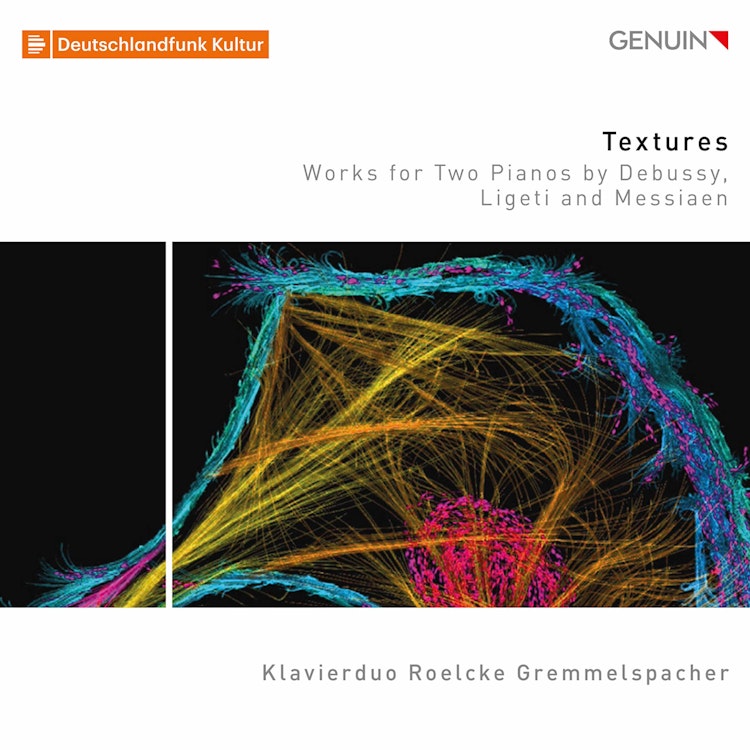
The album title "Textures" refers to György Ligeti's frequent use of the term "complex musical textures" and the concept of complexity in music.
Compositional Technique
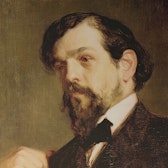
Claude Debussy's compositional process involves additive procedures, such as adding notes to chords, which causes them to lose their traditional harmonic function and creates a rich palette of tone colors.
Compositional Technique
In Ligeti's Three Pieces for Two Pianos, he uses polymetric and polyrhythmic techniques, requiring two performers to densify sound textures, and employs key blocking to create illusory rhythms and unpredictable overlaps.
Composer's Artistic Vision
For György Ligeti, the creation of complex structures was a creative act, stemming from his affinity for natural sciences and mathematics, combined with musical visions.
Performer Biography
Irmela Roelcke, one of the pianists on this album, has a focus on rediscovering and presenting rarely-performed or forgotten piano and chamber music, including the world's first recording of Artur Schnabel's Piano Quintet.
You might also enjoy...
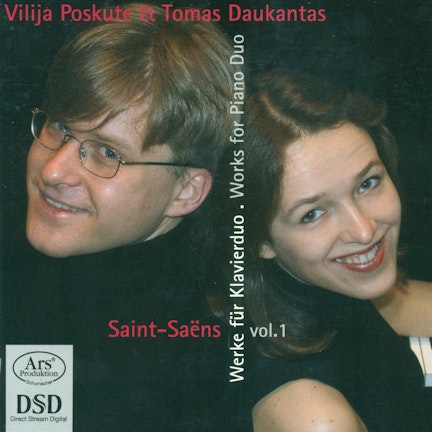
Saint-Saens, C.: Piano Duos, Vol. 1 - Suite Algerienne / Variations On A Theme of Beethoven / Scherzo
Dialogues
Dialogues
Three Suites for Two Pianos
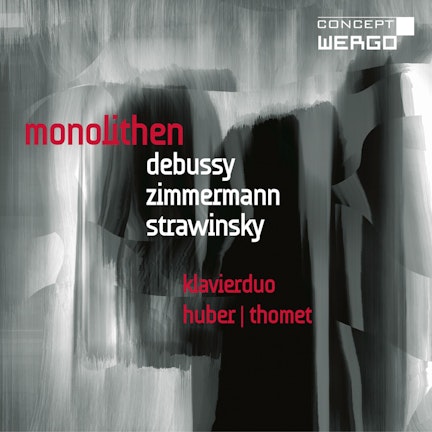
Debussy, Zimmermann & Strawinsky: Monolithen
Debussy: Piano Transcriptions
Rachmaninoff for Two
Mozart / Stravinsky / Debussy: Masterpieces for Two Pianos