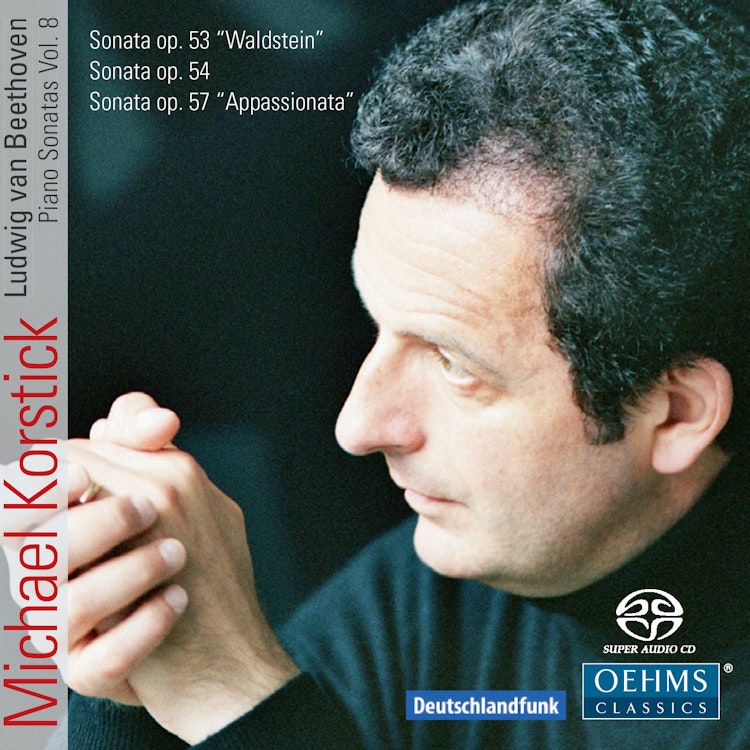
The Beethoven Cycle, Vol. 8 - Piano Sonatas Opp. 53, 54, 57
5/16/2011, 8 Tracks, 57:38
Featuring
Michael Korstick
Ludwig van Beethoven
Did you know?
1/7
Composition History
Beethoven's Sonata in C major op. 53, known as the 'Waldstein' Sonata, was dedicated to Count Ferdinand von Waldstein, his patron from his early days in Bonn.
Cultural Impact
The 'Appassionata' nickname for Beethoven's Sonata in F minor op. 57 was added posthumously and without authorization by publisher August Cranz in 1838.
Recording & Production
Pianist Michael Korstick chose to include his 2003 recording of Beethoven's Sonata op. 53 in this cycle because he views a recording as the sum of his experiences with a work, striving for timeless validity.
Composer Biography
After composing the Sonata in F minor op. 57, Beethoven did not write another piano sonata for five years, and rarely returned to the classical three-movement form.
Compositional Technique
Beethoven's Sonata in F major op. 54 is considered an experiment in structure, blurring the lines between a three-part sonata-allegro form and a two-part structure with an extended coda.
Instruments
In 1803, Beethoven received a new grand piano from Erard in Paris with an extended range of five-and-a-half octaves, which influenced his compositions.
Critical Reception
Beethoven's Sonata in F major op. 54 is one of his most misunderstood pieces, having received negative opinions and half-hearted vindications from critics.