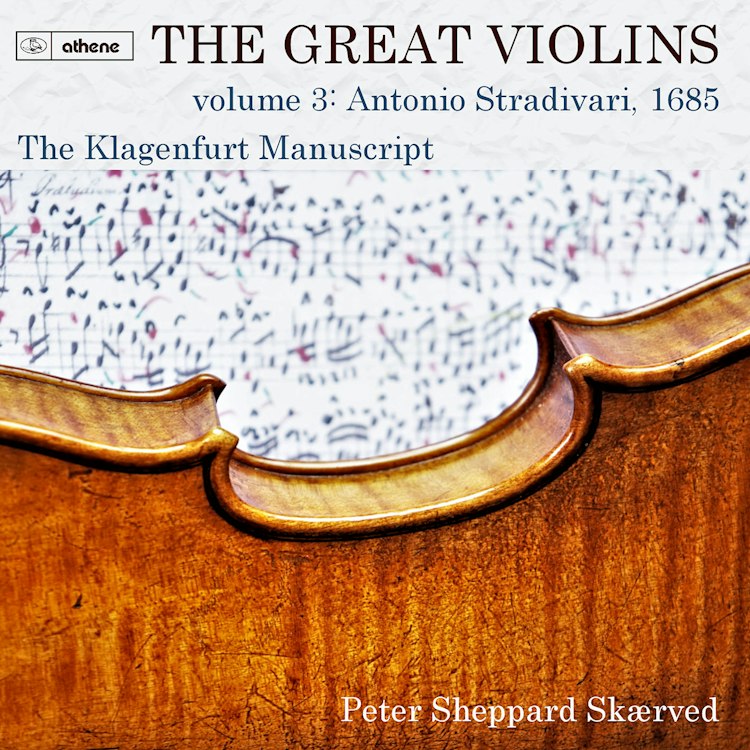
The Great Violins, Vol. 3: Antonio Stradivari, 1685
3/13/2020, 96 Tracks, 2:22:13
Featuring
Peter Sheppard Skærved
Anonymous
Did you know?
1/7
Recording & Production
The soloist uses a bow made by Genoese archetier Antonino Airenti, modeled on 17th-century Italian and Austrian bows, with a shorter hair band and fewer hairs than modern bows.
Composer Biography
The soloist, Peter Sheppard Skærved, speculates that the anonymous composer of the Klagenfurt Manuscript was likely a nun or lay sister working in the convent.
Compositional Technique
The Klagenfurt Manuscript extensively uses 'scordatura', an Italian term for retuning the violin strings from the standard GDAE to other combinations, creating different timbres and colors.
Historical Context
The convent where the Klagenfurt Manuscript was found had been rebuilt into a community of around 50 nuns and lay sisters by the time these works were composed.
Instruments
The recording features a violin made by Antonio Stradivari in 1685, which is part of the Royal Northern College of Music's collection.
Composition History
The Klagenfurt Manuscript, dating from the mid-1680s, was discovered in the Convent of St. Georgen am Längsee in Carinthia, Austria.
Interpretation
The soloist found that the 1685 Stradivari violin, with its smaller size and relatively low arching, responded well to the various scordatura tunings required by the manuscript.
You might also enjoy...
Weinberg: 24 Preludes, Op. 100 (Arr. G. Kremer for Violin)