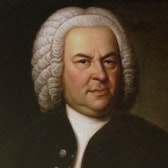
Bach viewed "The Art of Fugue" and other instrumental cycles, like the "Well-tempered Clavier" and "Goldberg Variations," as the finest examples and quintessence of his art, even printing them at his own expense.
Performer Biography
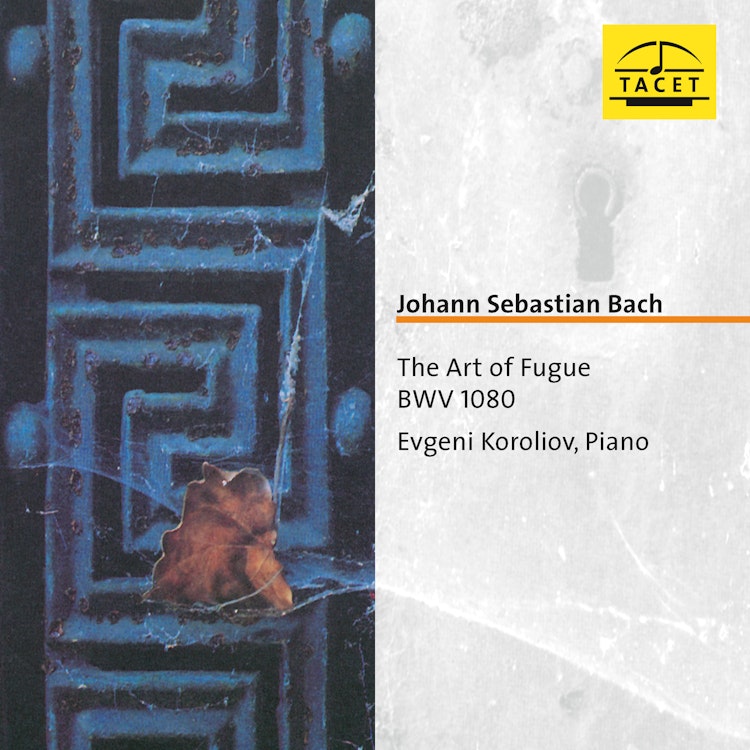
Evgeni Koroliov, the pianist on this recording, has a deep connection to Bach's work, having performed the entire "Well-tempered Clavier" in Moscow at the age of seventeen.
Composition History
Recent research indicates that Bach began composing "The Art of Fugue" in the early 1740s, much earlier than previously thought, and focused on its publication closer to his death.
Composition History
For two centuries, "The Art of Fugue" was believed to be Bach's final work and artistic legacy, with the image of an aged Bach writing his last fugue as death overtook him.
Compositional Technique
In "The Art of Fugue," Bach aimed to demonstrate all possible contrapuntal techniques within a fugue, contrasting with the "Well-tempered Clavier" which explored the fugue as a compositional form.
Compositional Technique
Bach used the archaic term "Contrapunctus" for his fugues, which his contemporary Johann Mattheson defined as "the art of drawing together various melodies, so that suddenly a complex harmony is created."
Composition History
It was once assumed "The Art of Fugue" was an "abstract showpiece" not intended for public performance, mainly because Bach wrote it as a score without specifying instruments.
You might also enjoy...
Bach: The Well-Tempered Clavier
Bach: Inventions & Sinfonias
Bach: The Two and Three Part Inventions, BWV 772-801 - Gould Remastered
Bach: Inventions et sinfonies à deux et trois voix, BWV 772 - 801
Bach: The Art of the Fugue, Fugues 1 - 9
Bach: Inventionen und Sinfonien / Französische Suite V
Glenn Gould Plays Bach Vol. 2
Récital à Saint-Frambourg: Couperin, Rameau, Marais & Daquin
Bach: Inventions & Sinfonias BWV 772-801
J.S. Bach: Prelude & Fugue in C Sharp Minor (Well-Tempered Clavier, Book I, No. 4), BWV 849