The Huelgas Ensemble performs four madrigals by earlier composers between the sections of Monteverdi's Mass, highlighting works that pushed artistic boundaries.
Compositional Technique
Unlike Renaissance composers who used 'real answers' to motifs, Monteverdi emphasized 'tonality' in his Mass, as seen in the bass entry of the Kyrie.
Composition History
Claudio Monteverdi's six-part Mass, featured on this album, was published in 1610 alongside his Marian Vespers, a work of a very different, more innovative character.
Compositional Technique
Monteverdi's Mass is not a 'parody Mass' in the traditional sense; instead, he used ten carefully selected motifs from Gombert's motet as material for his own polyphonic procedures.
Composer's Artistic Vision
Monteverdi intended his six-part Mass as a demonstration of his mastery of polyphonic imitative techniques used by an earlier generation of composers.
Recording & Production
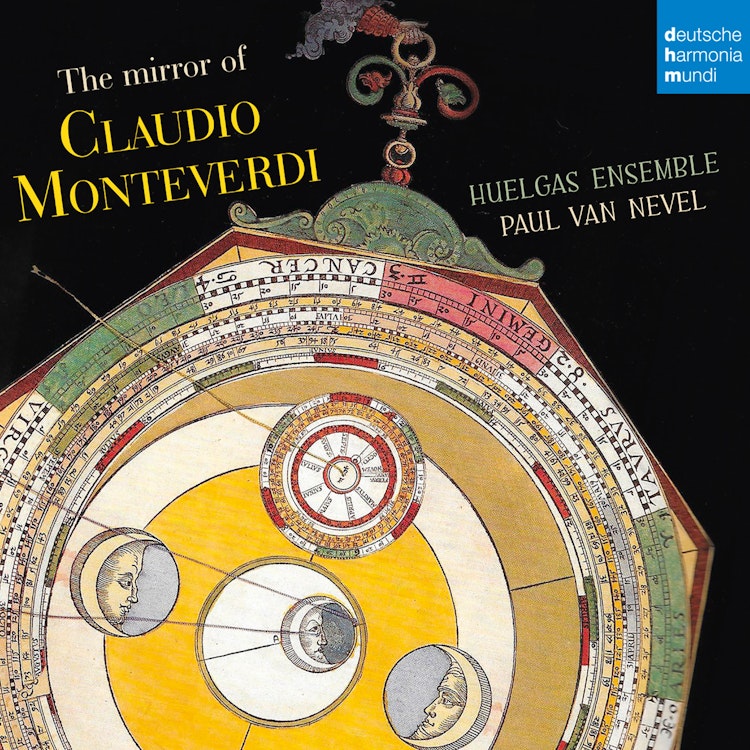
The album's cover features a volvelle by Petrus Apianus, an instrument for calculating the length of natural days and determining astronomical hours.
Compositional Technique
Monteverdi's use of melodic sequences and densely woven imitative passages in this Mass is so extensive that it can be described as a 'neo-Renaissance style'.
You might also enjoy...
Ockeghem & Compère : Musiques au temps d'Anne de France
Si breve è 'l tempo. Madrigals in the Low Countries
Fire and Water: The Spirit of Renaissance Spain
Ockeghem: Les chansons
A Renaissance Collection
Queen of Hearts: Laments and Songs of Regret for Queens Terrestrial and Celestial
Madrigals & Sacred Songs
Johannes Ockeghem: Complete Songs, vol. 2
Johannes Ockeghem: Complete Songs, Vol. 1
The Magic of Polyphony
Gesualdo: Madrigals
Busnois: Missa O Crux lignum - Motets - Chansons
Among Whirlwinds
Her Heavenly Harmony: Profane Music From the Royal Court