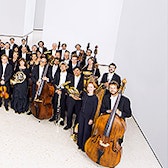
The Thief of Bagdad (Reconstructed Silent Film Score) [Live]
3/4/2022, 39 Tracks, 1:14:49
Featuring
Mark Fitz-Gerald
hr-Sinfonieorchester
Mortimer Wilson
Did you know?
1/7
Composer's Artistic Vision
Douglas Fairbanks instructed Mortimer Wilson, the composer, to make his score as artistic as possible, without feeling pressured to change moods rapidly at the expense of musical development.
Composer Biography
Mortimer Wilson, the composer, had already shown an interest in motion pictures, having published 'Silhouettes from the Screen, Op. 55' in 1919, with movements dedicated to silent film stars.
Composition History
Douglas Fairbanks' commission for Mortimer Wilson to create the orchestral score for The Thief of Bagdad was revolutionary, making the composer a creative collaborator from the start.
Composition History
Mortimer Wilson was present throughout the rehearsals and shooting of 'The Thief of Bagdad', constantly taking notes and ideas for the characters and moods.
Compositional Technique
Mortimer Wilson's score for 'The Thief of Bagdad' uses a moderate-sized orchestra, possibly to make it accessible to smaller cinemas.
Critical Reception
Despite initial opposition and an attempt to replace Mortimer Wilson's score with a compilation, critics later made Wilson's score famous across the United States.
Compositional Technique
The score for 'The Thief of Bagdad' contains allusions to other composers' styles, such as Puccini's 'Vissi d'arte' and Wagner's 'Valkyrie steeds'.
You might also enjoy...
Obsession
STEINER: Adventures of Mark Twain (The)
Legami (Original Motion Picture Soundtrack)
Mother’s Broom
Tonfilmschlager
Liebermann: Philharmonisches Konzert / Hindemith: Concerto für Jazzband and Sinfonieorchester
Howard Shore: Anthology – The Paris Concerts
John Williams Legacy
Arnold, M.: Film Music, Vol. 1
Cambissa: Orchestral Works
Lights, Camera...Music! Six Decades of John Williams