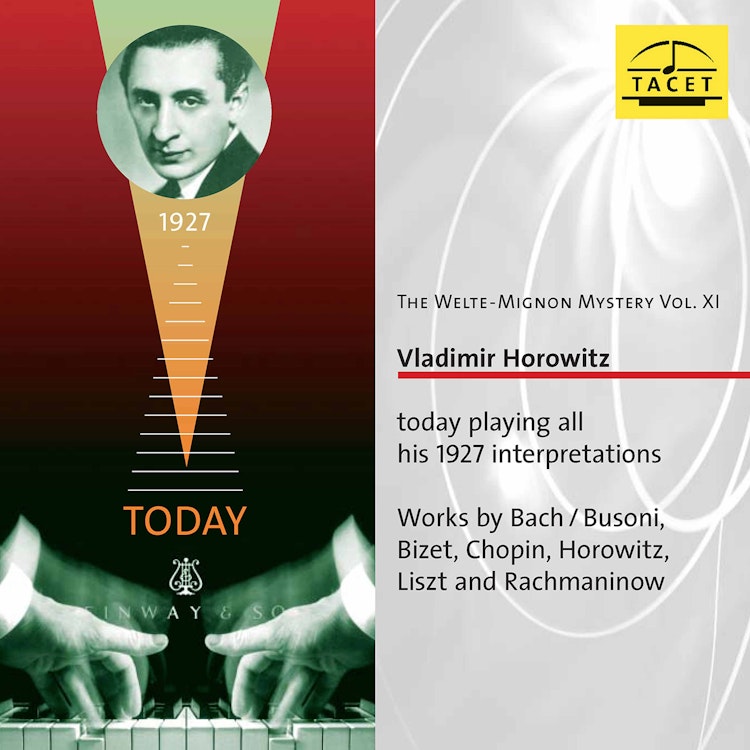
The Welte Mignon Mystery, Vol. 11: Vladimir Horowitz
1/1/2021, 12 Tracks, 1:09:07
Featuring
Vladimir Horowitz
Sergei Rachmaninoff
Franz Liszt
Ferruccio Busoni
Frédéric Chopin
Did you know?
1/7
Composition History
Horowitz's own Carmen Fantasie, a bravura piece based on themes from Bizet's opera, was created because he found Pablo Sarasate's version too 'tame' while accompanying Nathan Milstein, leading him to improvise and compose his own.
Performer Biography
Vladimir Horowitz's Welte recordings are the earliest known sound documents of his playing, offering a glimpse into his turbulent career years around 1926-1927.
Recording & Production
This album is not a historical recording; instead, it uses modern recording techniques to reproduce original 1927 interpretations by Vladimir Horowitz on a modern Steinway piano.
Critical Reception
When the Welte-Mignon system was first demonstrated, the press hailed it as 'the latest wonder of the world' for its ability to reproduce piano performances automatically.
Composer Biography
Vladimir Horowitz, the pianist featured on this album, was a child prodigy who began studying at the Kiev Conservatoire at age nine and was known for his self-willed nature and unique playing technique.
Instruments
The Welte-Mignon system, invented in 1904, was a player piano that could record and authentically reproduce 'all the subtleties of a pianist's performance' using perforated paper rolls.
Historical Context
Welte-Mignon player pianos were expensive and found in the homes of aristocracy and high society, as well as in grand hotels and ocean liners between Hamburg and New York.
You might also enjoy...
Liszt · Chopin ‧ Schubert ‧ Mendelssohn
Nikolai Lugansky: The Verbier Festival Debut Recital 2006
Steinway Legends: Maurizio Pollini
Levitzki: Complete Works for Solo Piano
Fur Elise - Romantic Piano Music
Sergio Fiorentino: The Legacy, Vol. 1
Blackwood, Easley: Radical Piano
Blechacz, Rafal: Piano Recital
Ruth Laredo Plays Rachmaninoff - The Complete Solo Piano Music