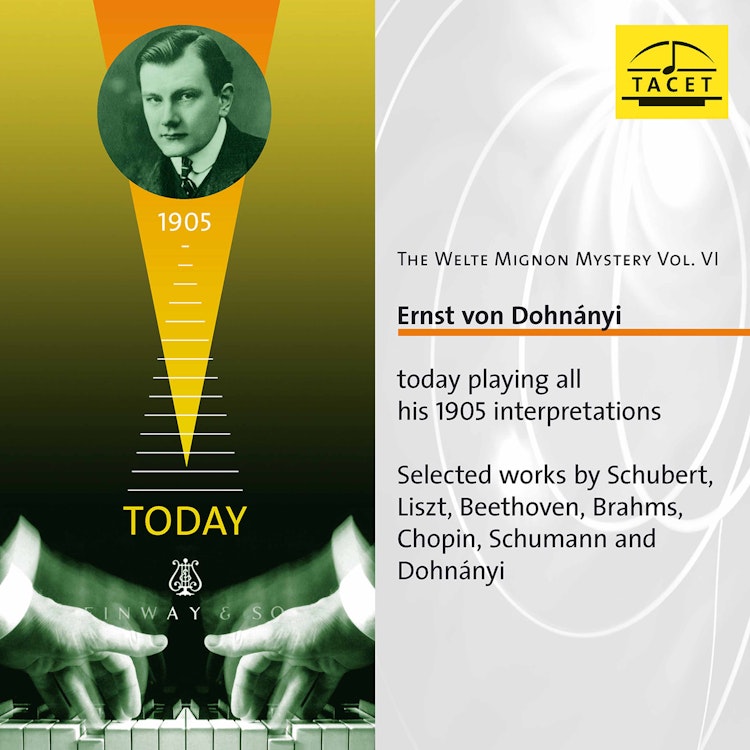
The Welte Mignon Mystery, Vol. 6: Ernst von Dohnányi
1/1/2021, 13 Tracks, 1:23:41
Featuring
Ernö Dohnányi
Franz Schubert
Franz Liszt
Ludwig van Beethoven
Johannes Brahms
Frédéric Chopin
Robert Schumann
Did you know?
1/7
Recording & Production
This album is not a historical recording; instead, it uses modern recording techniques to reproduce original interpretations from 1905 via a Welte-Mignon player piano.
Interpretation
In the early 20th century, concert-goers often valued a pianist's individuality more than strict fidelity to the composer's intentions, leading to interpretations that might seem unusual today.
Composer Biography
Ernst von Dohnányi, a piano virtuoso, composer, and conductor, made these Welte-Mignon recordings in 1905 while working in Berlin, playing his own compositions and works by other masters.
Recording & Production
The Welte-Mignon system records piano performances digitally using perforated paper rolls, capturing dynamic nuances and pedal activations.
Historical Context
The Welte-Mignon system allowed pianists, for the first time, to hear their own performances immediately after recording, sometimes revealing their own failings.
Historical Context
The Welte-Mignon player piano was hailed as a 'wonder of the world' by the press upon its first demonstration and was found in aristocratic homes, grand hotels, and ocean liners.
Instruments
The Welte-Mignon, invented in 1904, was a player piano system that could record and reproduce all the subtleties of a pianist's performance using perforated paper rolls.
You might also enjoy...
Voyageurs
Romeo & Juliet: Tchaikovsky on the Piano
A Survey of Czech Piano Cycles from Romanticism to Modernism
Piano Recital: Antti Siirala
A Dream
Pioneers: Piano Works by Female Composers
Invitation To The Dance
French Piano Music: Debussy, Ravel, Chabrier, Saint-Saëns & Satie