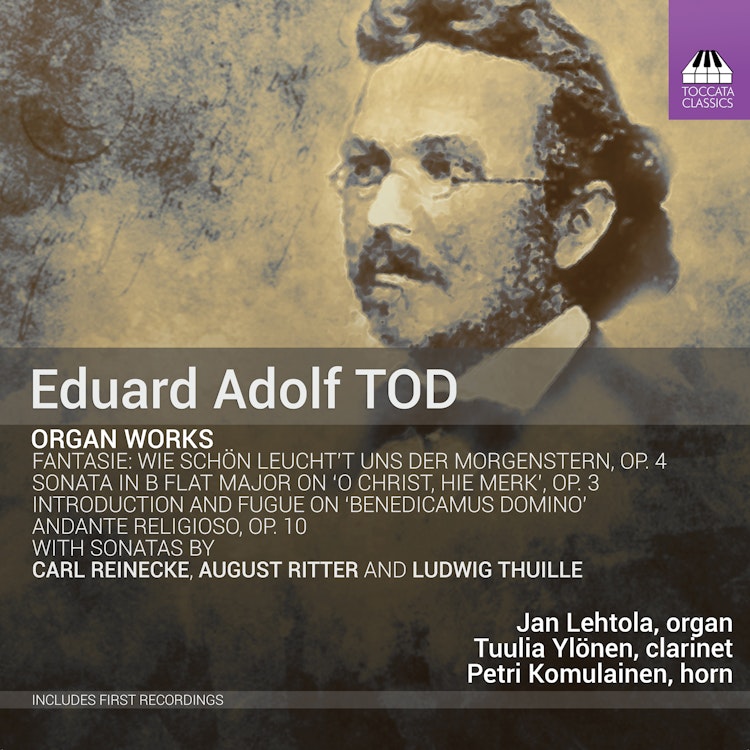
Another common characteristic of 19th-century German organ sonatas was the frequent appearance of a fugue to end a sonata, demonstrating the composer's command of counterpoint.
Recording & Production
This recording features performances on the restored Walcker organ in the Johanneskirkko, Helsinki, which was returned to its 1921 condition by German organ expert Christian Scheffler in 2005.
Performer Biography
Petri Komulainen, who plays horn on this album, has been associate principal horn in the Lahti Symphony Orchestra since 2001 and has recorded as both a horn-player and a conductor.
Instruments
The Walcker organ in the Johanneskirkko (St John's Church) in Helsinki, built in 1891, was one of the first pneumatic instruments made by the German manufacturer Walcker.
Performer Biography
Jan Lehtola, the organist on this recording, has given over 150 world and regional premieres and regularly collaborates with composers.
Compositional Technique
The organ sonata in the 19th century often incorporated a chorale, either as thematic material or as a quasi-quotation, possibly to legitimize a secular genre in a church setting.
Instruments
The Walcker organ in Helsinki was originally characterized by a German-Romantic sound, which was bass-note-oriented with an 8-foot sound, and reeds that added color rather than dynamic variation.
You might also enjoy...
Petrali: Complete Organ Works
Handel: Romantic Organ Transcriptions
Freu dich Erd und Sternenzelt
David Dahl in Concert
Organ Recital: Bowyer, Kevin - Gade, N. / Syberg, F. / Norgard, P. / Nielsen, C.
Neilsen: Commotio for Organ
The Organ of St. Brygida's Church in Gdansk
In the Silence of the Night
Woyrsch: Complete Organ Music
St. Mark's Cathedral, Seattle: Thomsen Chapel Inaugural Recitals
Brahms / Rheinberger / Schumann / Reger: Organ Works