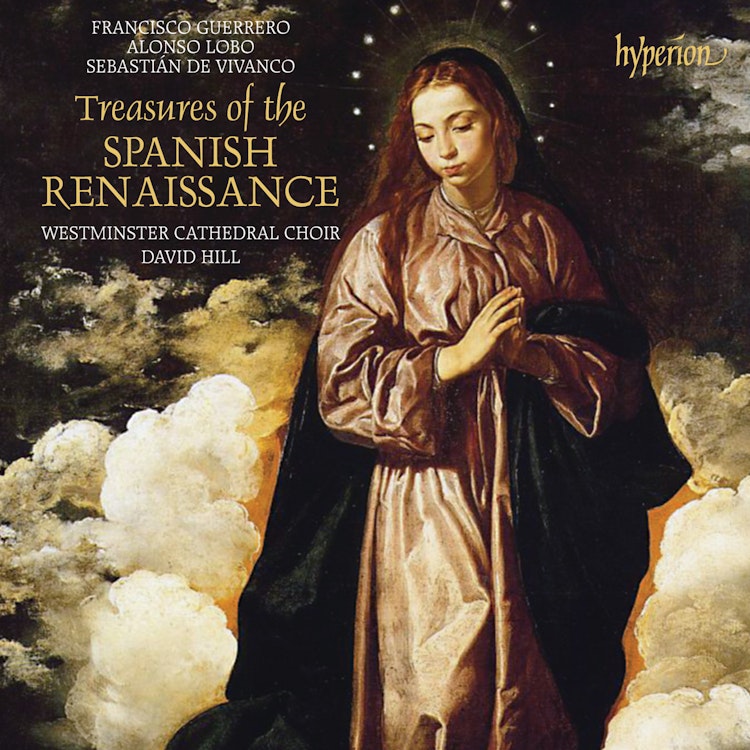
Guerrero's works, particularly his motet "Ave virgo sanctissima," were more widely known in Spain and its Empire, including Mexico, Lima, and Bogotá, than those of any other composer.
Composer Biography
Francisco Guerrero, the most influential composer in Spain during the time of Philip II, served as maestro de capilla at Seville Cathedral, the wealthiest Spanish cathedral.
Historical Context
Alonso Lobo's works were used in Spain, Portugal, and Mexico for over two centuries after his death, with copies found in major centers like the Sistine Chapel and the New World.
Recording & Production
The music on this recording has been edited by Bruno Turner, Martyn Imrie, and Donald James, with finely printed editions available from Mapa Mundi.
Composer's Artistic Vision
Guerrero's motet "Surge propera" clearly reflects the Church's interpretation of the Song of Songs, using the text "Veni sponsa Christi" as an ostinato to emphasize its sacred meaning.
Instruments
Spanish cathedrals from around 1580 increasingly used the harp, alongside the organ and dulcian, as a standard continuo instrument for choirs, especially in festive multi-voiced works.
Compositional Technique
Alonso Lobo's motets, along with those of his contemporaries Esquivel and Vivanco, are recognized for their uniquely Spanish style, which differs from the Roman smoothness found in Palestrina and Victoria.
You might also enjoy...
Many are the wonders
The Flowering of Renaissance Choral Music
Gloria Tibi Trinitas
Music of Tomas Luis de Victoria
Choral Recital: Osnabruck Youth Choir - Weelkes, T. / Tallis, T. / Lassus, O. / Ludovico Da Vittoria / Gesualdo, C. / Lotti, A. / Palestrina, G.P.