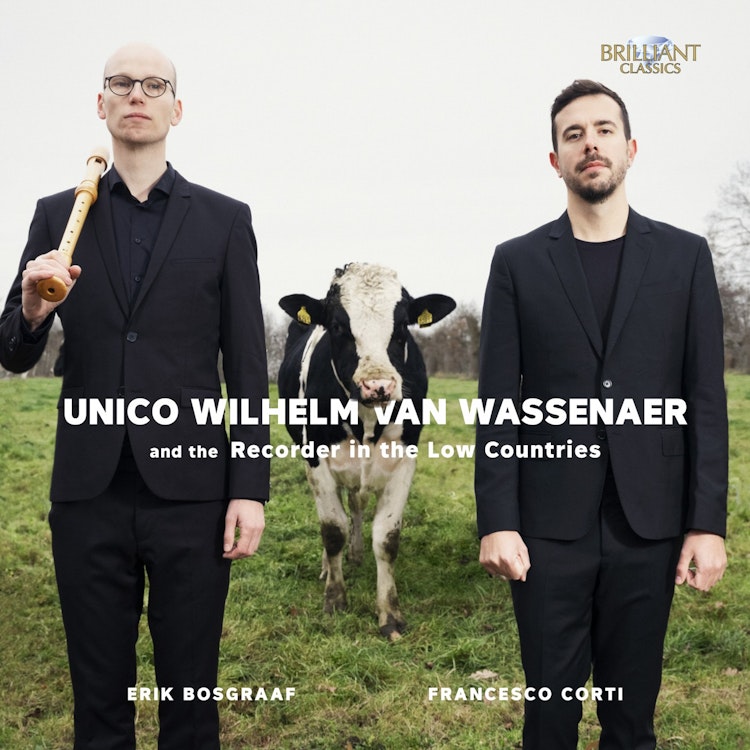
Van Wassenaer and the Recorder in the Low Countries
7/26/2019, 38 Tracks, 1:19:54
Featuring
Erik Bosgraaf
Francesco Corti
Unico Willem van Wassenaer
Jean-Baptiste Loeillet of Ghent
Andrew Parcham
Jean-Marie Leclair
Joseph-Hector Fiocco
Johann Christian Schickhardt
Sybrandt van Noordt
Did you know?
1/7
Historical Context
Around 1700, music flourished in the Dutch Republic despite lacking a royal court and having Calvinism, which limited church music to psalm singing.
Composer Biography
Andreas Parcham, whose only extant recorder sonata was published in Amsterdam in 1701, was mistakenly believed to be English for many years due to the title of the volume, but he was born in Danzig (present-day Gdansk, Poland).
Performer Biography
Erik Bosgraaf, one of the world's leading recorder players, has had around a hundred pieces composed for him, including twelve concertos, and received permission from Pierre Boulez to adapt his clarinet composition for recorder.
Instruments
The recorder was a favorite instrument of the wealthy upper class in the Dutch Republic around 1700, with first-class recorder makers working there and many sonatas published in Amsterdam.
Composer Biography
Unico Wilhelm van Wassenaer, a Dutch count and amateur musician, was only identified as the composer of the well-known VI Concerti Armonici in 1979, after they had been attributed to various other composers for centuries.
Recording & Production
This recording features a variety of recorders, including sopranino, soprano, alto, tenor (voice flute), and bass, with different instruments used for specific tracks.
Instruments
The recorder underwent a revolutionary development in the second half of the 17th century, changing from a single piece of wood to a three-jointed instrument with a more refined sound, originating in French court circles.
You might also enjoy...
Merry Christmas From Vienna
Morricone, E.: 4 Pictures From New York / The Mission / Sean Sean / My Heart and I / Rota, N.: 8 1/2 / Amarcord / La Dolce Vita