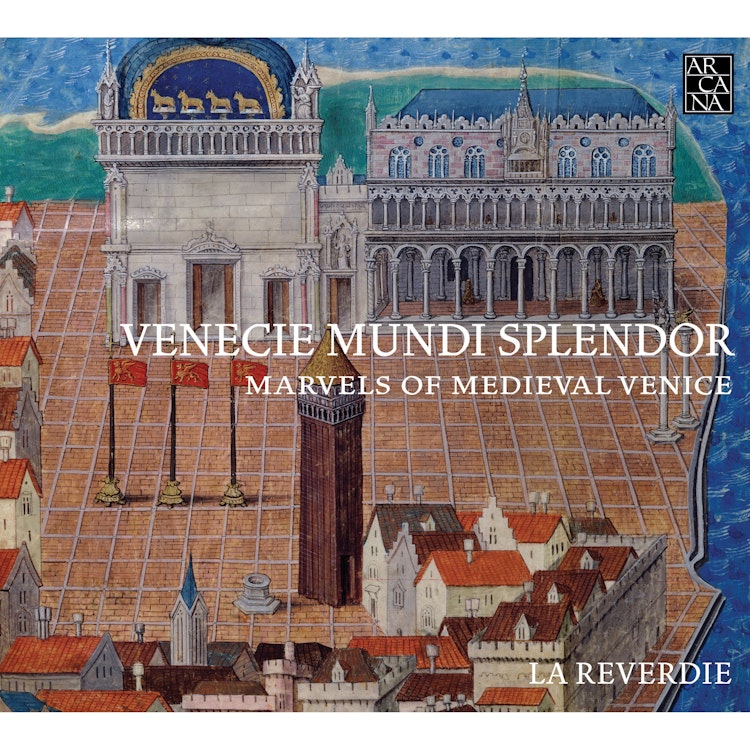
Venecie mundi splendor: Marvels of Medieval Venice
8/28/2015, 12 Tracks, 56:58
Featuring
Claudia Caffagni
Elisabetta de Mircovich
Doron David Sherwin
Matteo Zenatti
LaReverdie
Marchetto da Padova
Anonymous
Francesco Landini
Johannes Ciconia
Antonius Romanus
Hugo de Lantins
Cristoforo Monte
Did you know?
1/7
Composition History
The motet 'Venecie mundi splendor' by Johannes Ciconia, a composer active in Padua, was composed for the ceremony of Padua's annexation to the Venetian Republic in 1406.
Recording & Production
This recording was made at the Palladian Refectory of the Fondazione Giorgio Cini Onlus, located on the Island of San Giorgio Maggiore in Venice.
Composer Biography
Antonius Romanus is the first documented 'magister cantus' (master of song) at Saint Mark's Basilica in Venice, cited in documents from 1420 and 1425.
Historical Context
This album explores how music, specifically the motet genre, played a significant role in medieval Venice for state events like the investiture of the doge or the annexation of new territory.
Composition History
The tradition of using motets for state events in Venice began during the time of Doge Francesco Dandolo (1329-39) with Marchettus de Padua's 'Ave corpus sanctum gloriosi Stefani/Adolescens protomartir'.
Compositional Technique
Italian motets of this period are typically three-voice compositions, rarely four, often featuring canon between the two upper voices and a freely composed tenor without text.
Performer Biography
Claudia Caffagni, co-founder of the ensemble La Reverdie, is also a musicologist who teaches Medieval Music and Early Music Notation.
You might also enjoy...
Eternal Echoes
Mark John McEncroe: Fanfare Suite
Flavio Motalla: L'amore è poesia – Vocalises for Soprano & Orchestra
DIVISION: The Virtuoso Consort (Works by John Jenkins)
UrVerk
Alessandro Scarlatti: Responsories for Holy Week - Holy Saturday
Alessandro Scarlatti: Responsories For Holy Week - Holy Saturday