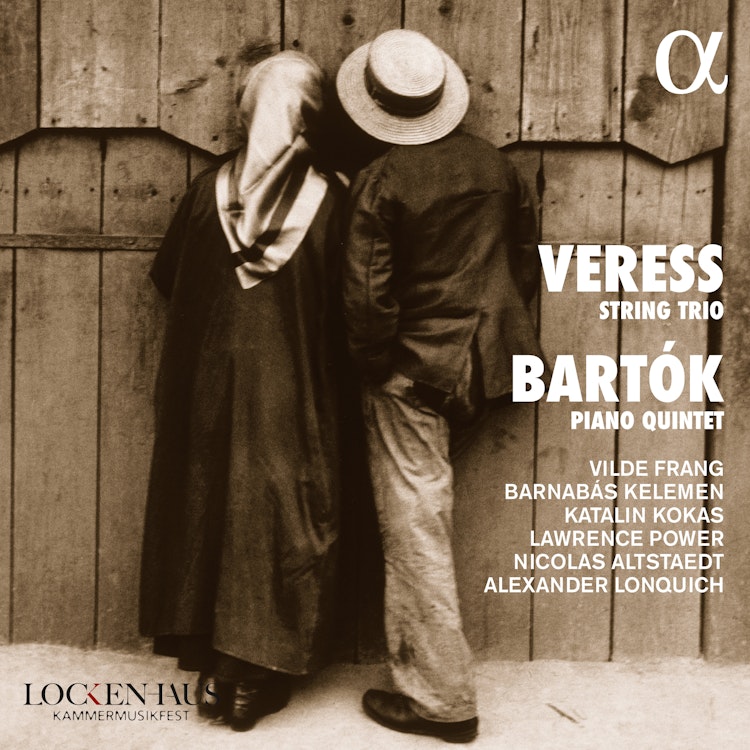
Cellist Nicolas Altstaedt, who succeeded Gidon Kremer as director of Austria's Lockenhaus International Chamber Music Festival in 2012, plays Bartók's Piano Quintet in C major with chamber music partners including violinists Vilde Frang and Barnabás Keleman. Altstaedt is also joined by Frang and violist Lawrence Power for a rarity: the String Trio of Sándor Veress, a student of Bartók's. Gramophone Award 2020. BBC Music Magazine Award Nominee 2020.
Featuring
Vilde Frang
Lawrence Power
Nicolas Altstaedt
Barnabás Kelemen
Katalin Kokas
Alexander Lonquich
Sándor Veress
Béla Bartók
Did you know?
1/7
Composition History
Bartók began composing his Piano Quintet in Berlin in autumn 1903 and completed it during his summer holidays in Gerlicepuszta, then northern Hungary (today part of Slovakia), the following year.
Composer Biography
Sándor Veress, composer of the String Trio, studied composition with Zoltán Kodály and piano with Béla Bartók at the Liszt Academy.
Composer's Artistic Vision
Sándor Veress, when describing his compositional approach, stated, 'I start off with the melody, then eventually get to a note-row. The 'serialists' begin with the note-row and get … nowhere at all - certainly not as far as an actual melody!'
Notable Performances
Bartók's Piano Quintet premiered in Vienna on November 21, 1904, with the composer himself performing at the piano alongside the Viennese Quartet Prill.
Composition History
The manuscript for Bartók's Piano Quintet, believed lost, was discovered in 1963 and served as the basis for its first edition in 1970.
Compositional Technique
Sándor Veress's String Trio, written in 1954, is a synthesis of Schoenberg's twelve-tone technique and tonal-harmonious principles, also incorporating folk music inspiration.
Critical Reception
At a 1921 concert, Bartók became so furious when an audience member claimed his early Piano Quintet was better than his later works that he threw the score to the floor.
You might also enjoy...
Dvořák: Piano Quintet No. 2 & String Quintet
Dohnanyi: Piano Quintets Nos. 1 and 2 - Kodaly: Serenade
Alabiev - Arensky - Medtner: Piano Quintets
Impressions d'enfance
Wolf-Ferrari: Trios & Duos for Strings
Beach: Piano Quintet in F-Sharp Minor / Theme and Variations / Piano Trio in A Minor
Dvorak: Quintet, Op. 81, in A, Francaix: Trio in C