Villa-Lobos met Andrés Segovia, a renowned Spanish classical guitarist, in Paris in 1923 or 1924, leading to a lifelong friendship where Segovia performed his works and Villa-Lobos provided new compositions.
Composer Biography
Heitor Villa-Lobos, despite composing over 1,500 pieces, is primarily known to the wider public for his Bachianas Brasileiras and a handful of guitar works.
Recording & Production
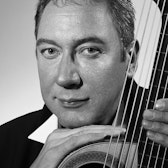
For this recording, guitarist Anders Miolin used a copy of the demanding Tenth Etude that includes an improvisation, claiming to be from the original manuscript, making this the first recording of this 'Fisk' version.
Composer Biography
Villa-Lobos, who taught himself guitar using textbooks by Carcassi, Carulli, and Sor, became an excellent guitarist himself, making the first commercial recordings of his own works like Chôro I and Etude I.
Composition History
A turning point in Villa-Lobos's life came in 1922 when pianist Artur Rubinstein helped him travel to Europe to publicize his music and organize concerts of Brazilian music.
Compositional Technique
Villa-Lobos's Twelve Etudes, inspired by Andrés Segovia, are pioneering works that introduced previously unheard sounds on the guitar, such as parallel chord movements against open-string 'pedals'.
Historical Context
Villa-Lobos was deeply interested in Brazilian urban folk music, particularly 'chôro' music, which referred to the occasions, musicians, and the music itself, often played by ensembles similar to a traditional jazz band.
You might also enjoy...
Elogio de la Guitarra, Krzysztof Meisinger plays works by Castelnuovo-Tedesco, Llobet, Piazzolla & Rodrigo
Andrés Segovia Archive: Grand Finale
Satie: Gnossienne No. 1 (Arr. Dyens for Guitar)
Manuel M. Ponce, Complete Works for Guitar, Vol. 2
21st Century Spanish Guitar, Vol. 1
Corea: Children's Song No.1
Castelnuovo-Tedesco: Appunti, Op. 210
Tailleferre: Guitare
Villa-Lobos: 5 Preludes, W419, A419: No. 3 in A Minor (Homage to Bach)
Snétberger: Your Smile
Granados: Escenas Románticas: VI. Epílogo (Transc. Feuillâtre for Guitar)