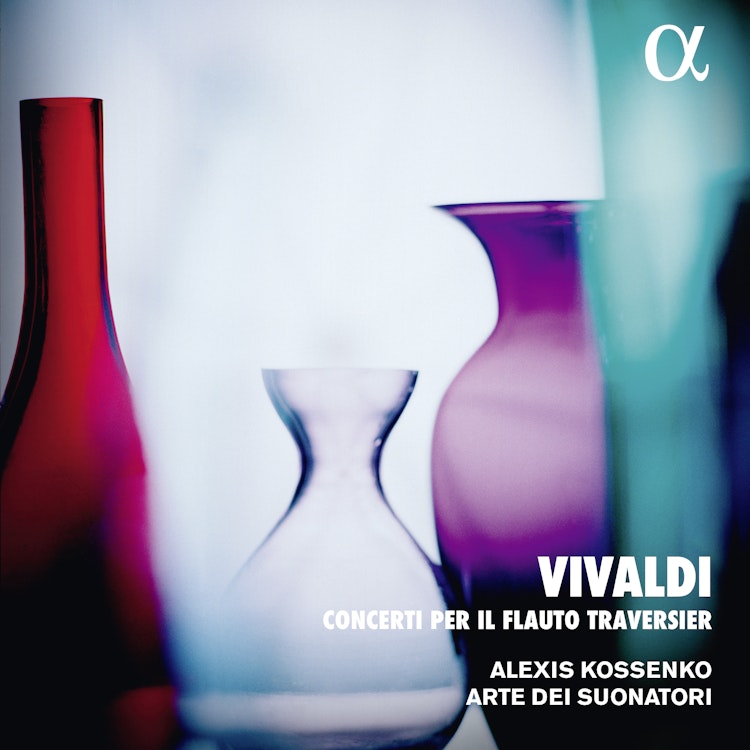
Vivaldi: Concerti per il flauto traversier (Alpha Collection)
11/4/2010, 26 Tracks, 1:17:00
Featuring
Alexis Kossenko
Arte dei Suonatori
Antonio Vivaldi
Did you know?
1/7
Instruments
Alexis Kossenko, the flutist and conductor, plays on a variety of historical flutes, including an ivory flute after Johann Eichentopf and ebony flutes after Thomas Stanesby Junior and Peter Bressan.
Interpretation
For Concertos RV 438 and RV 440, Vivaldi simplified passages, likely for a flautist with limited virtuosity; the performers on this album restored the original, more complex text.
Compositional Technique
The Concerto RV 436 shows Vivaldi's operatic influence with its dramatic concision, theatrical effects, syncopation, and rivalry between the two violin parts.
Compositional Technique
Vivaldi often composed movements by first writing the entire solo line, then adding the harmonization, which partly explains the flute doublings in the tutti sections.
Composition History
Vivaldi adapted several older works for Le Cène's 1729 publication, with only one, the Concerto in F major for recorder and strings (RV 434), already in modern concerto form.
Historical Context
In 1720s Holland, the transverse flute was very popular among amateur musicians, leading publisher Michel Le Cène to commission the first collection of flute concertos.
Composition History
The Concerto in G major RV 435 is unique in this collection as no earlier version is known, suggesting Vivaldi composed it specifically for Le Cène's 1729 publication.
You might also enjoy...
Vivaldi: Flute Concertos, Op. 10
Vivaldi: 6 Concertos
Vivaldi's Children - 6 Concerti, Op. 10
Vivaldi: The Four Seasons, Darmstadt Concerto, Concerto for Flute and Organ
Vivaldi: Original Flute Concertos
Vivaldi: The Four Seasons
Vivaldi: Edition Volume 2
Vivaldi: Concerto Il Gran Mogol for Flute, Strings & Continuo in D, RV431a
Vivaldi: Opera X - Sei concerti per flauto ed archi