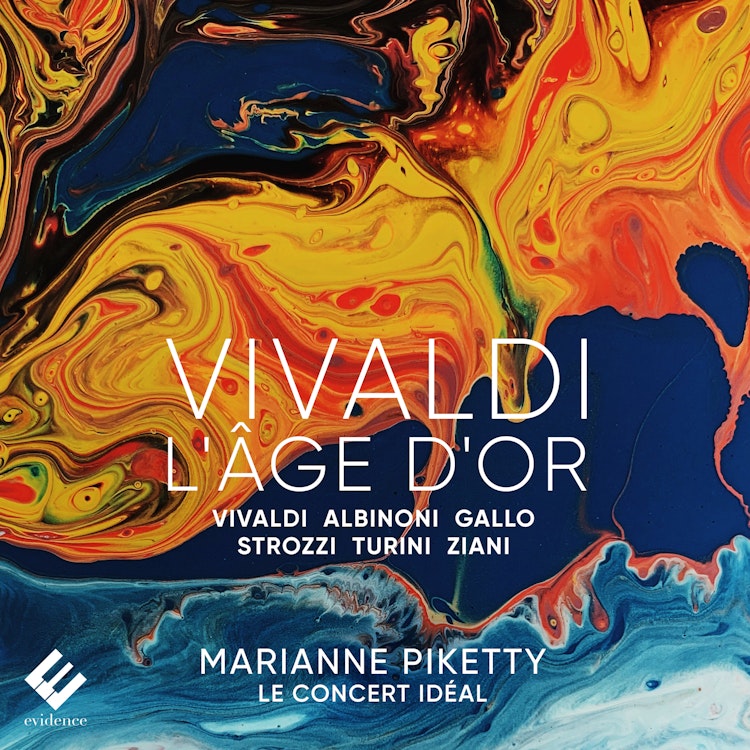
In 1771, music historian Charles Burney and philosopher Jean-Jacques Rousseau agreed that Venice was the best place for music in the world, unmatched by any other city.
Composition History
Vivaldi collaborated throughout his life with the Ospedale della Pietà, a hospice for abandoned children in Venice, where girls were trained to excel in music.
Composer Biography
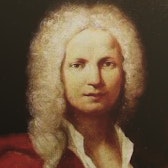
Antonio Vivaldi, known as the 'red priest' and an 'inimitable' violinist, came from the lower-class neighborhoods of Venice and was a significant opera impresario.
Recording & Production
This recording includes several world premiere recordings, such as Vivaldi's Sinfonia RV 739, Barbara Strozzi's 'Lagrime mie', and Francesco Turini's 'Sonata a tre 'Il Corisino' in an orchestral version by Olivier Fourés.
Historical Context
Venice, the City of the Doges, was a major European musical center from the early 16th century to the late 18th century, where opera, madrigal, sinfonia, sonata, concerto, song, and publishing flourished.
Compositional Technique
Francesco Turini's sonata 'Il Corisino' (1621) integrates a popular tune into three dances, secularizing polyphonic writing and confronting it with virtuoso ecstasy influenced by the newly discovered capabilities of the violin.
Critical Reception
Vivaldi's later works, such as his Concerto RV 390, were considered too 'brash' and theatrical for some tastes at the time, as the Venetian chiaroscuro began to fade with changing courtly etiquette and the Enlightenment.
You might also enjoy...
Segovia & His Contemporaries, Vol. 15
Taneyev, S.I.: Oresteya: Overture and Entr'Acte / Overture in D Minor / Overture On A Russian Theme
Flame Dance
Musica per banda
Chau Paris
Millennium Concert Live
Hands Across The Sea - Marches From Around The World
Great Classic Film Music (Live)
Pavarotti & Friends Together For The Children Of Bosnia