The Four Seasons were dedicated to Count Wenzel von Morzin, Vivaldi's patron, who had four allegorical statues of the seasons in his Prague palace, suggesting he commissioned the musical counterpart.
Composer's Artistic Vision
Vivaldi's choice of keys in The Four Seasons creates a 'perpetual motion' where the third of each season's tonic key drops by a semitone in the next, leading back to the starting point like an 'Escher staircase'.
Compositional Technique
Vivaldi included sonnets and descriptive comments in the score of The Four Seasons, guiding performers to imitate sounds like barking, flies, thunder, or even chattering teeth.
Critical Reception
Upon publication, The Four Seasons caused a stir, with Louis XV demanding performances and violinists like Guignon and Gaviniès gaining fame through them, though some critics dismissed them as 'amusement for children' or 'tricks'.
Cultural Impact
The Four Seasons significantly influenced musical grammar for the violin and instrumental composition, impacting later styles like Sturm und Drang, Beethoven's Pastoral Symphony, and even modern rock and minimalist music.
Composition History
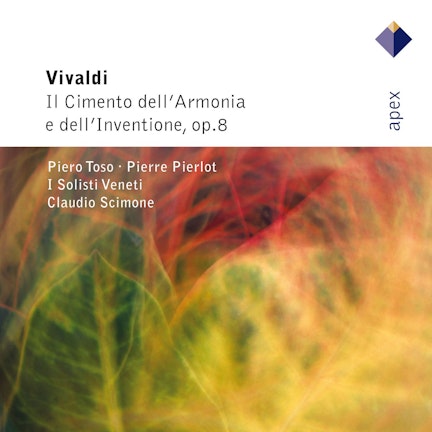
Vivaldi's Il cimento dell'armonia e dell'inventione, Op. 8, which includes The Four Seasons, was published in 1725 as a deluxe edition to regain control after previous pirate editions.
Interpretation
This album explores other Vivaldi works that use similar symbolic tonalities, such as E major for 'birth' and F minor for 'death', to reinforce the cyclical nature of the seasons.
You might also enjoy...
Vivaldi 5 Violin Concertos
Vivald i: Il cimento dell'armonia e dell'inventione Op.8 - APEX
Vivaldi: Il cimento dell'armonia e dell'inventione, Op. 8