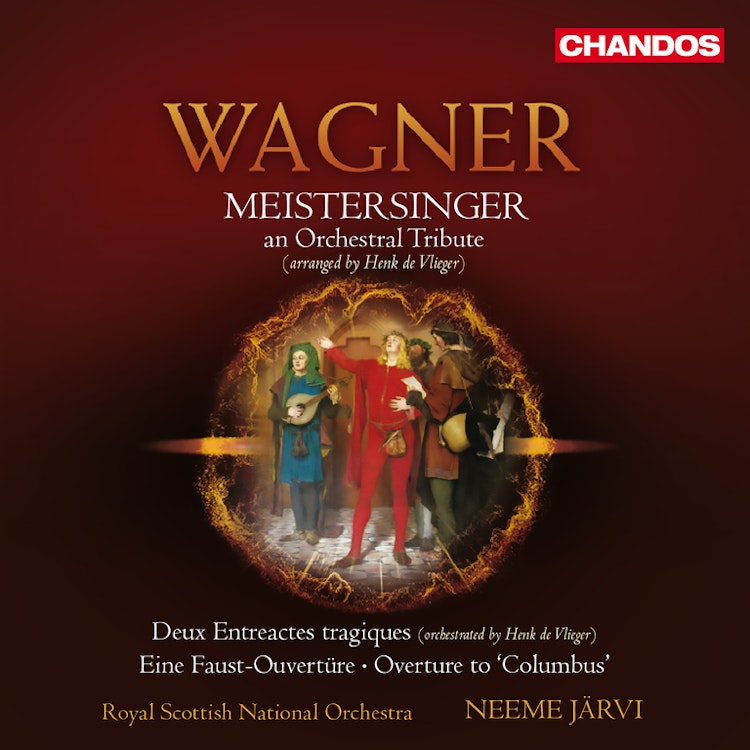
Wagner: Meistersinger - Deux Entreactes tragiques - Eine Faust-Overture - Overture to Columbus
9/6/2013, 15 Tracks, 1:19:53
Featuring
Neeme Järvi
Royal Scottish National Orchestra
Henk de Vlieger
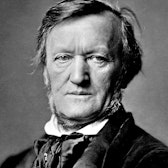
Richard Wagner
Did you know?
1/7
Composer Biography
Richard Wagner (1813-1883) took some time to mature as a composer, thoroughly revising his style in the 1850s to become the genius with whom the world would wrestle.
Compositional Technique
Around 1850, Wagner and Liszt were key figures in instrumental drama, prioritizing an intuitive sense of tension, relaxation, and proportion over inherited patterns, especially in large-scale works.
Composer's Artistic Vision
Wagner, as an operatic composer, believed that drama originated primarily from the music, not the text, with notes having the greatest dramatic impact.
Interpretation
Henk de Vlieger, the arranger, aimed to rewrite sections from Wagner's operas and shape transitions so that the listener experiences the work as a cohesive symphony rather than a potpourri.
Cultural Impact
After 1850, Wagner's Eine Faust-Ouvertüre, along with Berlioz's Symphonie fantastique, became a prime example of 19th-century program music.
Compositional Technique
Wagner amplified expressive devices from older traditions, such as suspensions and delayed dissonance resolution, through larger compositions, dominant instrumentation, and blurring vocal and instrumental writing styles.
Compositional Technique
Wagner's early instrumental pieces, like the Overture to Columbus, departed from typical Italian operatic overture forms, favoring a free alternation of slow and fast passages.
You might also enjoy...
Betrayals
Wagner: Orchestral Excerpts, Vol. 2
Wagner: Overtures, Preludes & Orchestral Excerpts
Overtures and Preludes [Angel]
Wagner: Preludes & Overtures
Music of Wagner
Wagner: Orchestral Music; Lohengrin; Tristan und Isolde; Die Meistersinger von Nürnberg