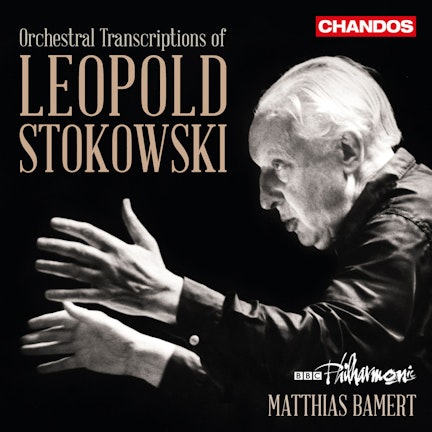
Stokowski's 'symphonic syntheses' of Wagner's operas were intended as extended symphonic poems, with seamless transitions between sections, rather than simple suites.
Interpretation
In his symphonic syntheses, Leopold Stokowski did not alter Wagner's original scoring, but replaced vocal lines with instruments, such as cellos for Tristan's lines and violins for Isolde's.
Performer Biography
Leopold Stokowski, a conductor, was a great advocate of Richard Wagner's music, conducting and recording it often throughout his career.
Recording & Production
Leopold Stokowski and the Philadelphia Orchestra introduced Wagner's music to a wider public through a series of 78rpm gramophone records featuring 'Symphonic Syntheses'.
Interpretation
Leopold Stokowski experimented with orchestral seating, sometimes placing woodwinds to his right or basses on high podiums at the back, to enhance sound balance and visibility.
Performer Biography
José Serebrier, the conductor on this album, was hailed by Leopold Stokowski as 'the greatest master of orchestral balance' when Serebrier was 21 years old.
Compositional Technique
Leopold Stokowski enhanced existing published scores for his symphonic fragments from The Ring, sometimes doubling violin runs with piccolos for brilliance or removing 'padding' to clarify inner voices.
You might also enjoy...
Delius: Orchestral Works
Stokowksi: Toccata und Fuge
Delius: Brigg Fair & On Hearing the First Cuckoo in Spring & In a Summer Garden