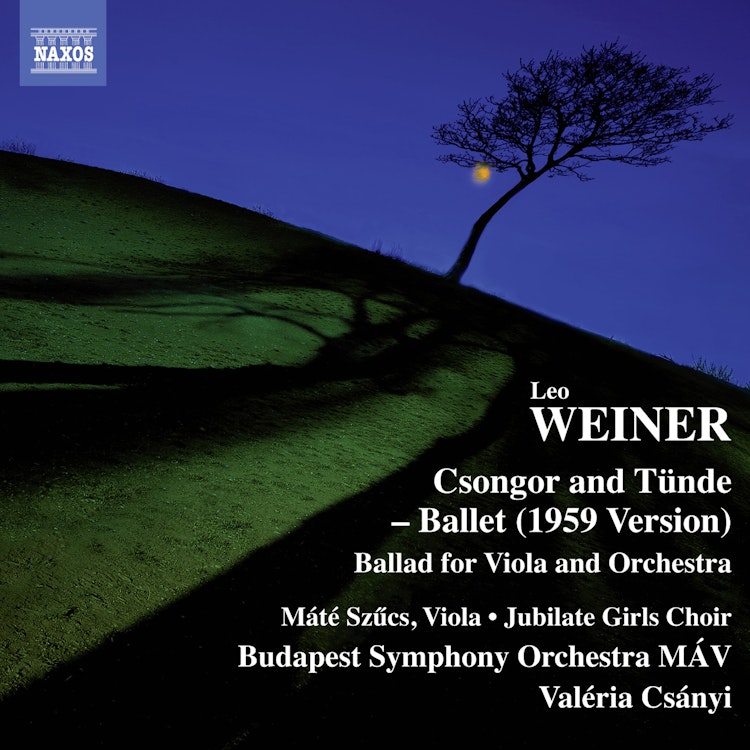
Weiner: Csongor és Tünde, Op. 10 & Ballada, Op. 28
8/5/2016, 15 Tracks, 1:06:09
Featuring
Máté Szűcs
Valéria Csányi
MÁV Szimfonikus Zenekar
Jubilate Choir
Leó Weiner
Did you know?
1/7
Composer's Artistic Vision
Leo Weiner composed true Hungarian music without directly using folk melodies, instead synthesizing the traditions of Schumann and Mendelssohn with European and Hungarian music of his time.
Recording & Production
This recording uses the more colorful 1949 orchestration of Leo Weiner's Ballad, Op. 28, which uses all woodwind instruments and is six bars longer than his previous version.
Composer Biography
Leo Weiner taught at the Liszt Academy in Budapest from 1907 until his death, where he had previously been a pupil of János Koessler, a representative of the Brahms tradition.
Composer Biography
Leo Weiner, the composer, began his musical studies on his own initiative and learned to compose by analyzing works of great composers, as his parents did not provide him with a musical education.
Composer's Artistic Vision
For Leo Weiner, folk music was a 'precious musical material' that he could stylize 'with refined artistic self-restraint' to make his works 'classical'.
Composition History
The ballet version of Csongor and Tünde on this album is the final, expanded version from 1959, which Leo Weiner thoroughly transformed to 14 movements, one year before his death.
Composition History
Leo Weiner's Csongor and Tünde, Op. 10, based on a dramatic poem by Mihály Vörösmarty, accompanied him throughout his life and he regarded it as his magnum opus.